
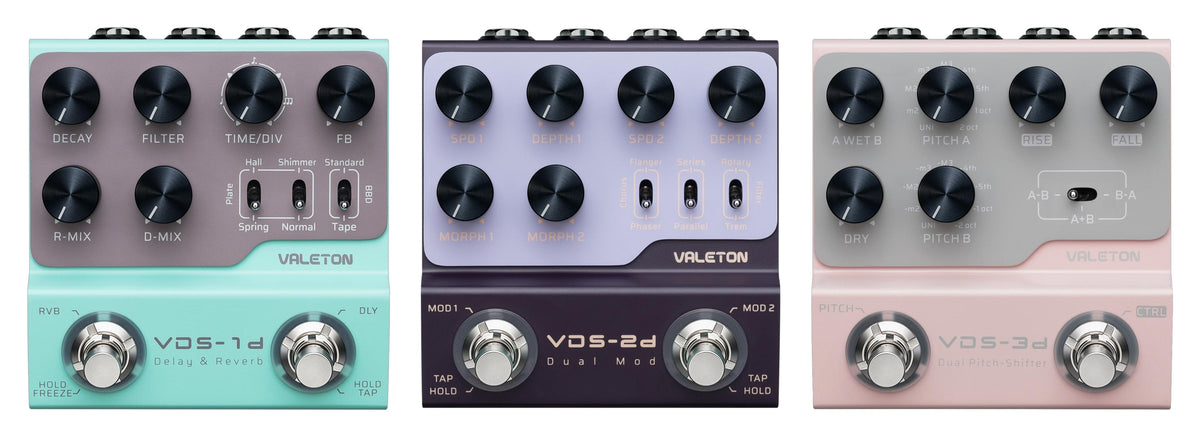
The three Valeton VDS pedals share the same dual-footswitch format, the same power requirements and the same stereo inputs and outputs. What separates them is the job they do on your board. Start from what is missing:
- Your board has no delay or reverb, and space is tight: the Valeton VDS-1D covers both in one enclosure, with three reverb types plus a Shimmer switch, three delay types, Reverb Freeze and Tap Tempo.
- You want two modulation effects at once: the Valeton VDS-2D pairs Flanger, Chorus or Phaser with Rotary, Filter or Tremolo, in series or parallel, with Tap Tempo on both channels.
- You want intervals or pitch glides from a footswitch: the Valeton VDS-3D adds one voice up to +2 octaves and one down to −2 octaves, with a CTRL footswitch for timed pitch transitions and selectable True or Buffered Bypass.
None of the three replaces the others. Delay and reverb, modulation and pitch shifting are different effect families, so the right choice depends on what is missing from your board, not on which model is "better".
VDS-1D vs VDS-2D vs VDS-3D at a glance
| VDS-1D | VDS-2D | VDS-3D | |
|---|---|---|---|
| Effect family | Delay and reverb | Dual modulation | Dual pitch-shifter |
| Effect types | Reverb: Hall, Plate, Spring + Shimmer/Normal switch. Delay: Standard, BBD, Tape | MOD 1: Flanger, Chorus, Phaser. MOD 2: Rotary, Filter, Tremolo | PITCH A: unison to +2 octaves. PITCH B: unison to −2 octaves |
| Left footswitch | RVB — press: reverb on/off; hold: Reverb Freeze | MOD 1 — press: on/off; hold: Tap Tempo | PITCH — press: pitch effect on/off |
| Right footswitch | DLY — press: delay on/off; hold: Tap Tempo | MOD 2 — press: on/off; hold: Tap Tempo | CTRL — triggers pitch transitions |
| Routing / modes | Delay and reverb usable alone or together | Series or Parallel routing of the two channels | Transition toggle: A-B, B-A, A+B |
| Tap Tempo | Yes — hold DLY; TIME/DIV selects the note subdivision | Yes — on both channels; tapping one side syncs the other when both are in Tap Tempo | Not one of its listed functions |
| Bypass | Selectable True Bypass or Buffered Bypass | Buffered bypass | Selectable True Bypass or Buffered Bypass (factory setting: Buffered) |
| Inputs / outputs | Inputs: L (Mono), R. Outputs: L, R | Inputs: L (Mono), R. Outputs: L, R | Inputs: L (Mono), R. Outputs: L, R |
Choose the VDS-1D if you need delay and reverb

The VDS-1D puts a delay and a reverb in one enclosure, each with its own footswitch and its own mix control (R-MIX for reverb, D-MIX for delay). You can run either effect alone or both at once.
- Reverb types: Hall, Plate and Spring, plus a Shimmer/Normal switch that adds a Shimmer effect to the reverb.
- Delay types: Standard, BBD and Tape, with TIME/DIV for delay time and FB for the number of repeats.
- Hold the left (RVB) footswitch for Reverb Freeze. Hold the right (DLY) footswitch for Tap Tempo; TIME/DIV then selects the note subdivision.
- Bypass can be set to True Bypass or Buffered Bypass. Whether delay and reverb tails continue after switching off depends on the bypass mode; tails cannot be set separately.
It fits ambient playing with Shimmer and Freeze, clean tones with Plate or Spring reverb and Tape delay, and leads that need delay set to the song tempo.
Choose the VDS-2D if you need modulation

The VDS-2D has two modulation channels, each with its own footswitch and its own SPD (rate), DEPTH and MORPH controls.
- MOD 1 offers Flanger, Chorus and Phaser. MOD 2 offers Rotary, Filter and Tremolo.
- You can combine one effect from MOD 1 with one from MOD 2—not any two of the six effects. For example, Chorus and Tremolo can run together, while Chorus and Phaser are alternatives on MOD 1.
- The Series/Parallel switch sets how the two channels are routed. In Series mode MORPH 1 sets the MOD 1 mix; in Parallel mode it sets the blend between MOD 1 and MOD 2. MORPH 2 changes function with the selected MOD 2 type: with Filter it sets the filter frequency, and with Tremolo it changes the waveform from triangle to square.
- Hold either footswitch for Tap Tempo. When both channels are in Tap Tempo, tapping one side syncs the rate of the other.
It fits players who want two modulation effects together, such as Chorus with Tremolo or Phaser with Rotary, with a choice of series or parallel routing and rates set to the song tempo.
Choose the VDS-3D if you need pitch shifting

The VDS-3D has two pitch-shift voices: PITCH A from unison up to two octaves and PITCH B from unison down to two octaves. Available intervals are unison, minor 2nd, major 2nd, minor 3rd, major 3rd, 4th, 5th, 1 octave and 2 octaves. A WET B sets the mix between the two voices, and DRY sets the dry signal level from 0 to 100%.
- The PITCH footswitch turns the effect on and off. The CTRL footswitch triggers pitch transitions chosen with the toggle: A-B, B-A or A+B. RISE and FALL set how long the transitions take.
- Bypass can be set to True Bypass or Buffered Bypass; the factory setting is Buffered Bypass.
With PITCH on:
| Mode | Press CTRL | Release CTRL |
|---|---|---|
| A-B | Glide from A to B | Return to A |
| B-A | Glide from B to A | Return to B |
| A+B | Glide from both shifted voices to unison | Return to both shifted voices |
With PITCH off, CTRL can glide from the dry signal to A, to B or to A+B and back. This requires Buffered Bypass mode.
It fits players who want an interval above or below the dry signal, two intervals at once with a set dry level, or timed pitch glides from a footswitch.
What all three have in common
- Power: 9V DC, center negative, 5.5 × 2.1 mm plug, 300 mA. Power supply not included.
- Connections: inputs L (Mono) and R, outputs L and R. For mono, use the L (Mono) input and the L output; for mono in, stereo out, use the L (Mono) input and both outputs; for stereo, connect both.
- USB: a USB port for firmware updates from a computer.
- Size and weight: 96 mm (L) × 100 mm (W) × 44.5 mm (H), 449 g.
- Warranty: 1 year, serviced by Pedalzoo for customers in Canada and the United States.
Power supply not included, so plan a 9V DC output for each VDS pedal and check voltage, polarity and current for each output. Our guide on how to power guitar pedals explains what to look for.
FAQ
Which VDS pedals have Tap Tempo? The VDS-1D (hold the DLY footswitch) and the VDS-2D (hold either footswitch). Tap Tempo is not one of the VDS-3D's listed functions; its footswitches are PITCH and CTRL.
Can I combine any two modulation effects on the VDS-2D? No. You can combine one effect from MOD 1 (Flanger, Chorus or Phaser) with one from MOD 2 (Rotary, Filter or Tremolo). Effects on the same channel are alternatives.
When does the VDS-3D need Buffered Bypass? When you want CTRL to glide from the dry signal while PITCH is off. Bypass mode can be set to True Bypass or Buffered Bypass; the factory setting is Buffered Bypass.
Is a power supply included with the VDS pedals? Power supply not included. Each pedal needs 9V DC, center negative, 5.5 × 2.1 mm plug, 300 mA.
Technical specifications are based on Valeton’s product documentation. Usage tips are provided by Pedalzoo.