

About This Item
Description
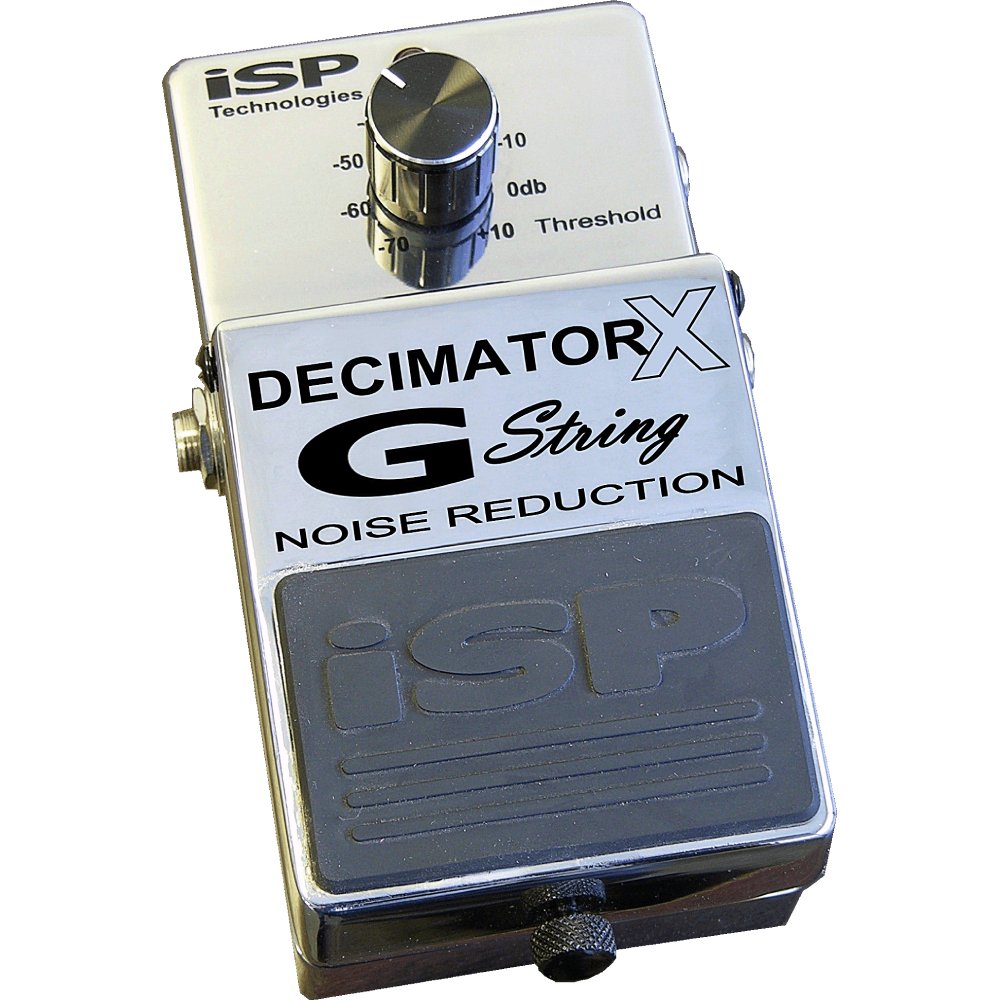
Adds a dedicated Guitar In/Out plus a separate Dec In/Out loop to ISP's newest noise-reduction technology, so it can track your guitar directly while still cleaning up noise from high-gain pedals or your amp's effects loop.
Because the detector reads the clean guitar signal at GUITAR IN, you can switch from clean to high gain without readjusting the threshold. The Decimator X technology is covered by US Patent 11,641,183: an Integration Release Window holds a slow release until a note has decayed by a set number of decibels, then follows only the negative peaks of the decaying envelope, and linearized Time Vector Processing keeps sustained notes decaying smoothly without release ripple.
Why guitarists choose this pedal
- Four 1/4-inch jacks (Guitar In, Guitar Out, Dec In, Dec Out) let it sit in front of the amp while still cleaning noise from an effects loop or downstream pedal chain
- Tracks the guitar signal directly, so the noise floor doesn't shift when you change gain pedals or preamp settings
- LINK IN/OUT lets it chain with a second Decimator or pair with a standard Decimator X for dual-channel or stereo noise reduction
- Same Integration Release Window technology as the standard Decimator X, tuned to remove modulation on slow-decaying notes
- Targets 60-cycle hum from single-coil pickups as well as pedal and amp hiss
Controls
- Threshold knob – adjust clockwise with no signal present until the noise floor is inaudible; readjust with guitar volume maxed
Connections & Power
- GUITAR IN and GUITAR OUT: 1/4" jacks
- DEC IN (loop send) and DEC OUT (loop return): 1/4" jacks
- LINK IN and LINK OUT: 1/8" jacks, connected with an RTS 1/8" cable
- Power: 9V DC, 35 mA, standard 5.5 mm barrel adapter (sold separately), or a 9V battery in the internal compartment
- Signal-chain placement: guitar → GUITAR IN; GUITAR OUT → gain pedals / amp input; amp effects-loop send → DEC IN, return → DEC OUT. Delay and reverb sit after the DEC OUT so their tails stay natural.
| Type | Adaptive noise reduction pedal with direct guitar tracking and effects loop |
|---|---|
| Technology | Decimator X, US Patent 11,641,183, Integration Release Window, linearized Time Vector Processing |
| Controls | Threshold |
| Jacks | 4 x 1/4" (Guitar In, Guitar Out, Dec In, Dec Out), 2 x 1/8" (Link In, Link Out), DC input |
| Power | 9V DC, 35 mA, 5.5 mm barrel; adapter sold separately |
| Battery | 9V (internal compartment) |
| Dimensions | 2.3" H x 2.7" W x 5" D (58 x 69 x 127 mm) |
| Introduced | 2024 |
FAQ
How do I hook up the four jacks? Connect your guitar to GUITAR IN, run GUITAR OUT to your gain pedals or amp input, connect DEC IN to your amp's effects loop send, and DEC OUT to the loop return; put gain pedals between GUITAR OUT and DEC IN (or in front of the amp) and delay/reverb after DEC OUT to avoid cutting off trails.
Why choose the G String version over the standard Decimator X? The G String version is the one to get when you need separate guitar and loop connections — for example, to track the guitar directly while also noise-reducing pedals placed in an amp's series effects loop. Tracking the clean guitar means the threshold does not need resetting when you switch between clean and high-gain sounds.
Can I build a stereo noise-reduction setup? Yes. The LINK IN/OUT jacks connect with an RTS 1/8" cable to a second Decimator, or to a standard Decimator X, for dual-channel or stereo operation.
Is this pedal battery powered? It has a 9V battery compartment and also runs from an external 9V DC adapter with a standard 5.5 mm barrel; it draws 35 mA. The adapter is sold separately.
Does it work for bass? Yes, the Decimator X pedals are intended for both guitarists and bassists.
What does the Integration Release Window do? It holds a slow release until a note has decayed past a set number of decibels and then slides with the decaying signal, so staccato playing gets a fast response while long sustained notes fade without choppy modulation.