
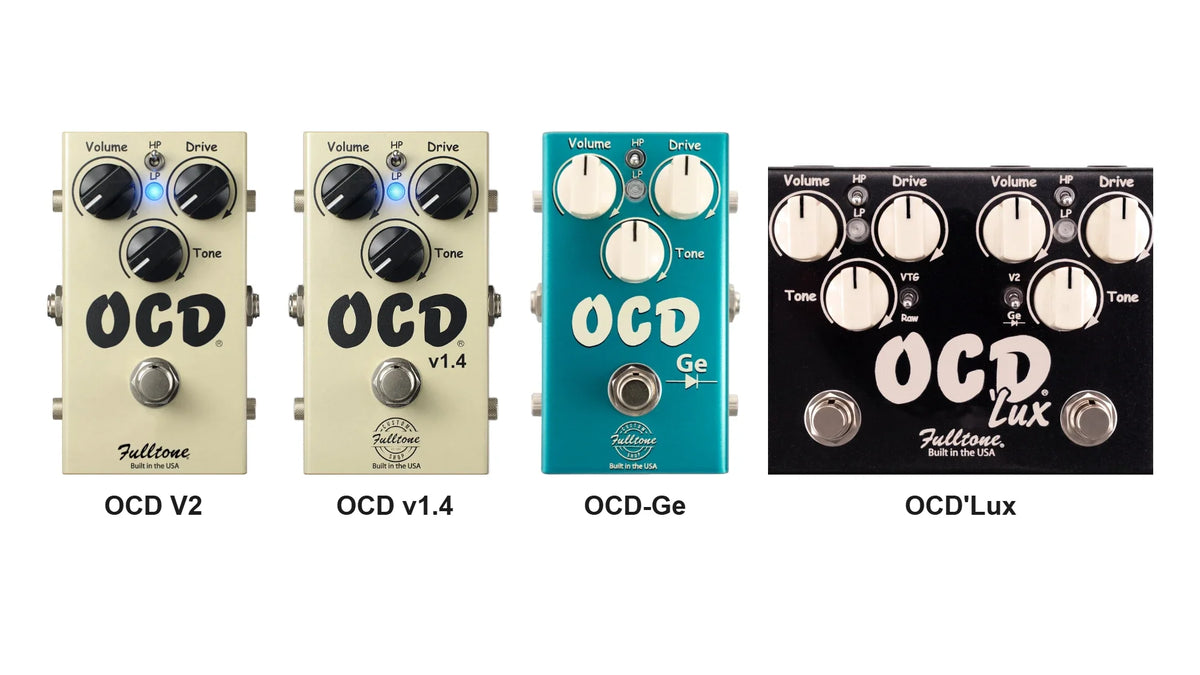
The Fulltone OCD (Obsessive Compulsive Drive) is one of the best-known analog overdrive pedals, and Fulltone now builds it in several forms. Whether you call it the OCD pedal, the OCD V2, the OCD V1.4 or the OCD germanium, Pedalzoo lists four of them: the current OCD V2, the Custom Shop OCD v1.4 reissue, the Custom Shop OCD-Ge with germanium diodes, and the OCD'Lux, a dual overdrive with four OCD voices. Below is how they compare on voicing, bypass, power and size, and which one to pick.
The quick answer
| If you want… | Best fit | Why |
|---|---|---|
| One OCD that covers most needs | Fulltone OCD V2 | Current production, MOSFET hard clipping, HP/LP switch, True or Enhanced Bypass |
| The original 2009 hand-wired voicing | Custom Shop OCD v1.4 | Part-for-part recreation of the 2009 OCD 1.4 board, true bypass only |
| A more dynamic, tube-like feel | Custom Shop OCD-Ge | Two MOSFETs plus two germanium diodes, Class-A JFET input |
| Two overdrives in one box | Fulltone OCD'Lux | VTG/RAW and V2/Germanium circuits, separate controls and footswitches |
| Not sure where to start | Fulltone OCD V2 | The everyday OCD, with the HP/LP voicing switch and switchable bypass |
What the Fulltone OCD does
Every OCD guitar pedal in this guide is an analog overdrive built around the same layout: Volume, Drive, Tone and an HP/LP switch. The clipping uses MOSFETs that hard-clip to a voltage reference, and the pedal is known for responding to pick attack and guitar volume. Back the guitar volume off and it cleans up toward a boost; dig in and it opens into crunch and lead tones.
- Drive sets the amount of overdrive. Low settings work as a transparent boost into an amp that is already working; higher settings move into crunch and lead.
- Tone shapes the high frequencies only.
- HP (High Peak) adds gain, output and a midrange push for a more British-style voice. LP (Low Peak) is flatter and more transparent, closer to the amp's own tone, which suits clean boost and stacking with other drives.
The four versions, one by one
Fulltone OCD V2
The current production OCD and the best starting point for most players. It has a Class-A discrete JFET input stage with 1 MΩ input impedance, HP/LP voicing and an internal switch for True Bypass or Enhanced Bypass. Compared with the older OCDs it is voiced tighter and more mid-forward, which helps it cut through a band mix.
Fulltone Custom Shop OCD v1.4
A part-for-part recreation of the original hand-wired OCD 1.4 board from 2009, the revision many players credit with putting the OCD on the map. It is voiced with fuller bass, a more open top end and less mid hump than the V2. It is true bypass only, and Pedalzoo's listing describes it as a limited run with no restock planned.
Fulltone Custom Shop OCD-Ge (germanium)
The Custom Shop OCD-Ge adds two matched germanium diodes to the two MOSFET clippers. Compared with the standard V2 it gives more definition, a wider dynamic range, more sustain and a rounder, more tube-like feel on single notes. It keeps the Class-A JFET input, the HP/LP switch and the internal True or Enhanced Bypass switch, and it uses an audio-taper Volume pot because it runs louder.
Fulltone OCD'Lux
The OCD'Lux puts four OCD voices into one dual overdrive with two independent circuits:
- Left circuit: VTG (the original OCD V1 voice) or RAW (a new, more aggressive and less compressed mode).
- Right circuit: V2 (the OCD V2 voice) or Ge (the Custom Shop Germanium voice).
- Each side has its own Volume, Drive, Tone, HP/LP switch and footswitch, plus separate inputs and outputs on four top-mounted jacks.
You can use either drive alone, stack them inside the pedal (right circuit into left), or put another effect between the two circuits using RIGHT OUT and LEFT IN.
OCD versions side by side

| OCD V2 | Custom Shop OCD v1.4 | Custom Shop OCD-Ge | OCD'Lux | |
|---|---|---|---|---|
| Circuits | 1 | 1 | 1 | 2 (VTG/RAW and V2/Ge) |
| Clipping | MOSFET hard clipping | MOSFET hard clipping with a single germanium diode | 2 MOSFETs plus 2 germanium diodes | Left: OCD V1 voices. Right: V2 or Germanium |
| Controls | Volume, Drive, Tone, HP/LP | Volume, Drive, Tone, HP/LP | Volume (audio taper), Drive, Tone, HP/LP | Volume, Drive, Tone, HP/LP on each side, plus voice switches |
| Bypass | True or Enhanced (internal switch) | True bypass only | True or Enhanced (internal switch) | Enhanced (factory) or True (internal switch) |
| Footswitches | 1 | 1 | 1 | 2 |
| Power | 9 V battery or 9–18 V DC | 9 V battery or 9–18 V DC | 9 V battery or 9–18 V DC | 9 V battery or 9–18 V DC |
| Current draw | about 8 mA | 8 mA | about 8 mA | 20 mA |
| Size (as listed) | 110 x 60 x 35 mm, enclosure only | 12 x 7 x 4 cm | 11 x 6 x 3.5 cm | 99 x 121 x 51 mm (3.9 x 4.75 x 2 in) |
| Made in | USA | USA | USA | USA |
All four use a 2.1 mm center-negative barrel connector. The battery and the power supply are not included with any of them.
Bypass, power and board space
- Bypass. True Bypass takes the circuit fully out of the signal path when the pedal is off. Enhanced Bypass keeps a buffered Class-A stage active, which helps preserve top end on long cable runs and long pedal chains. The V2, OCD-Ge and OCD'Lux let you choose with an internal switch; the v1.4 is true bypass only.
- Power. Running a regulated supply at 18 V gives more headroom. The single-circuit OCDs draw about 8 mA and the OCD'Lux draws 20 mA, so budget for that on a shared supply. See our guide to powering guitar pedals for voltage, current and polarity basics.
- Board space. The OCD'Lux is the largest at 99 x 121 mm, because it holds two circuits and two footswitches. If it replaces two separate drive pedals, it can still save room.
Which Fulltone OCD should you buy?
- Pick the OCD V2 if you want one reliable overdrive and are not chasing a particular revision.
- Pick the Custom Shop OCD v1.4 if you specifically want the 2009 voicing with fuller lows and less mid hump, and you are happy with true bypass only.
- Pick the Custom Shop OCD-Ge if you play single-note lines or rhythm with a lot of dynamics and want a softer, more tube-like response.
- Pick the OCD'Lux if you want to switch between two OCD flavors, or stack two drives, without building a two-pedal setup.
Older OCD versions: OCD V1 and V1.4 to V1.7
Fulltone has released the OCD in numbered revisions, and players searching for an "OCD V1" are usually looking for one of these. The Custom Shop v1.4 belongs to the Series 4 OCD family, which covers v1.4 to v1.7, and it recreates the original 2009 hand-wired board. The OCD V2 is the current production model and uses a different circuit layout. If you are shopping for an older numbered OCD, the Custom Shop v1.4 is the version Pedalzoo lists.
Other Fulltone overdrives
If the OCD voicing is not what you are after, Fulltone's Full-Drive family takes a different approach, using the JRC4558 chip and a selectable clipping switch instead of MOSFET hard clipping:
- Full-Drive 1: a single-channel overdrive with Volume, Drive, Tone and a 3-way CC / V / FM clipping switch.
- Full-Drive 2 V2: a two-channel overdrive with a second drive channel, its own volume and two clipping switches.
You can see the full range on the Fulltone collection.
FAQ
What is the Fulltone OCD pedal? The Fulltone OCD (Obsessive Compulsive Drive) is an analog overdrive pedal with Volume, Drive, Tone and an HP/LP switch. It uses MOSFET hard clipping and is known for reacting to pick attack and guitar volume.
What is the difference between the OCD V2 and the older OCD versions? The V2 is the current production model with a Class-A JFET input stage and a tighter, more mid-forward voicing. The Custom Shop v1.4 recreates the original 2009 hand-wired board, with fuller bass, a more open top end and less mid hump, and is true bypass only.
Is the Fulltone OCD an overdrive or a distortion pedal? Fulltone builds it as an overdrive. At low Drive it works as a transparent boost, and at higher settings it moves into crunch and lead tones.
Is there a germanium Fulltone OCD? Yes. The Custom Shop OCD-Ge adds two matched germanium diodes to the two MOSFET clippers, and the OCD'Lux has a Ge voice on its right circuit.
What does the HP/LP switch do? HP (High Peak) adds gain, output and a midrange push for a British-style voice. LP (Low Peak) is flatter and more transparent, which suits clean boost and stacking with other pedals.
Is the Fulltone OCD true bypass? It depends on the version. The OCD V2, OCD-Ge and OCD'Lux have an internal switch for True Bypass or Enhanced Bypass. The Custom Shop v1.4 is true bypass only.
Can I run the Fulltone OCD at 18 V? Yes. The OCD V2, OCD-Ge and v1.4 run on a 9 V battery or a 9–18 V DC supply with a 2.1 mm center-negative barrel plug, and the OCD'Lux uses the same 9–18 V range. 18 V gives more headroom. A regulated supply is recommended.
Is the OCD'Lux two OCD pedals in one? Yes. It has two independent circuits, each with its own Volume, Drive, Tone, HP/LP switch and footswitch. The left circuit offers VTG or RAW, and the right circuit offers V2 or Germanium.
What is the difference between the OCD V2 and the OCD-Ge? The OCD-Ge adds a pair of matched germanium diodes to the two MOSFET clippers. That gives more definition, a wider dynamic range, more sustain and a rounder, more tube-like feel on single notes. The OCD V2 clips with MOSFETs alone.
Which Fulltone OCD should I buy first? The OCD V2 is the straightforward choice: it is current production and has the HP/LP switch and switchable bypass.
Does the OCD come with a battery or power supply? No. Battery and power supply are not included with any of the four versions in this guide.
Where can I buy a Fulltone OCD in Canada? Pedalzoo lists the OCD V2, Custom Shop OCD v1.4, Custom Shop OCD-Ge and OCD'Lux with prices in Canadian dollars. Check each product page for current availability.