


About This Item
Description
MicroPitch is the trick behind countless records that sound bigger than the take: shift one side a few cents sharp, the other a few cents flat, add a handful of milliseconds of delay, and a single guitar becomes a wide, glued stereo image.
Which Eventide pitch pedal is this?
MicroPitch is the specialist: fine detuning plus short delay for width and thickening, not transposition. If you want harmonies, whammy-style dive bombs, diatonic shifting and octave work, that is the PitchFactor. If you want the detuning as one voice inside a chorus pedal, TriceraChorus carries a MicroPitch section alongside three chorus voices. The H9 Harmonizer Gen 2 includes MicroPitch among 74 or more algorithms if you would rather have one box do everything.
Why guitarists choose the MicroPitch
- Fine detuning across a stereo pair is the fastest way to widen a mono source without the obvious wobble of a chorus.
- A dedicated delay per side lets you go from a tight doubling to a slapback-length spread, which changes the effect from glue to a distinct second voice.
- Positive and Negative Envelope modulation sources make the detune respond to your picking dynamics instead of running at a fixed rate.
- Major and minor third intervals are available when you want an actual harmony rather than a few cents of shift.
- Eventide voices it for guitar, vocals, keyboards, drums, strings, brass and winds, so it earns a place in a studio as well as on a board.
- Five onboard presets and MIDI recall mean a subtle rhythm thickener and a wide lead sound live in the same pedal.
Controls and switches
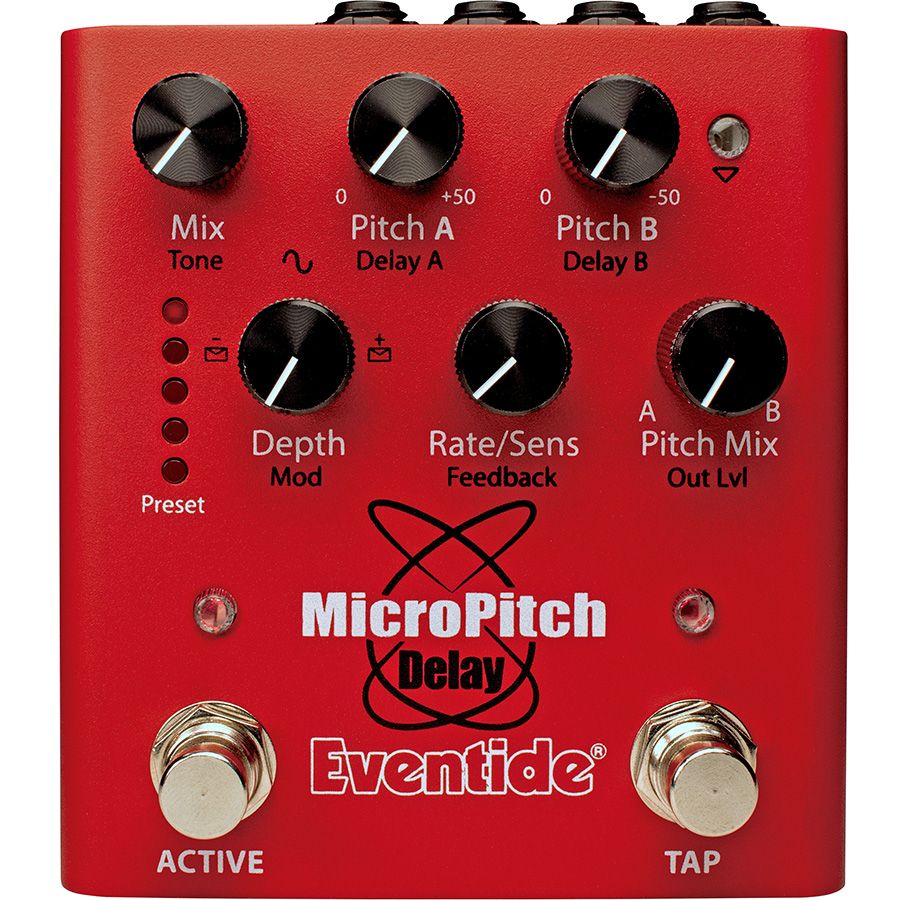
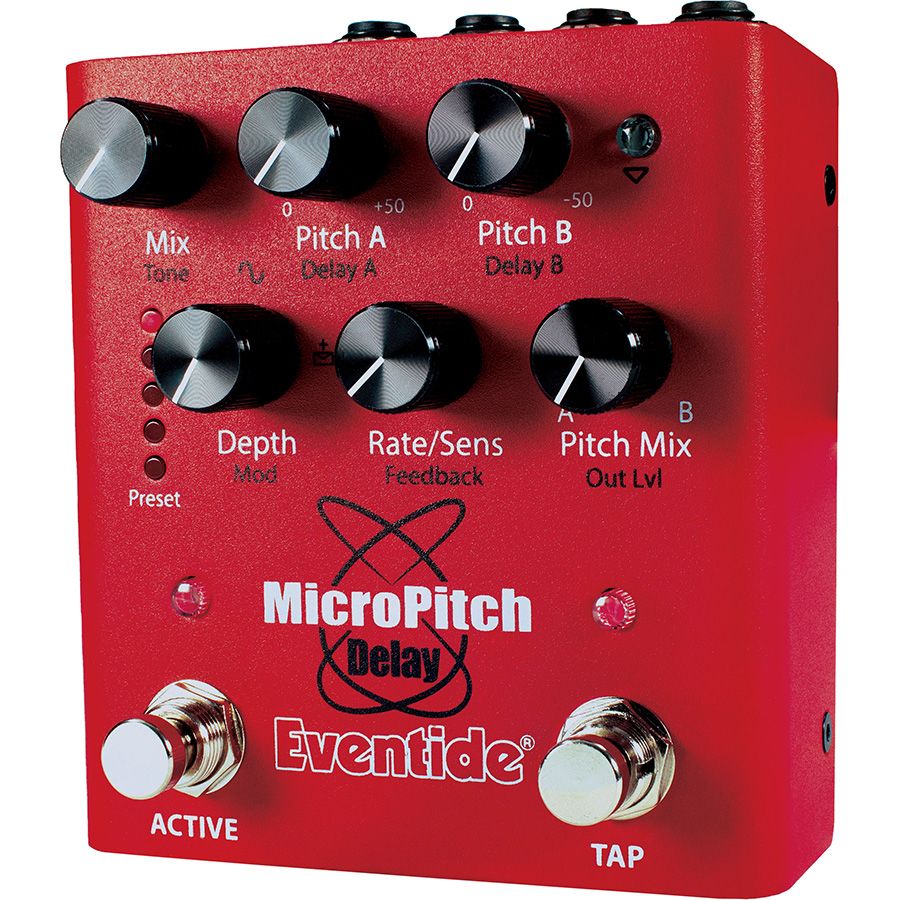
- PITCH A / PITCH B Set the detune amount for each side, from a few cents to major and minor third intervals.
- DELAY A / DELAY B Independent delay for each pitch voice, from doubling lengths up to a clear repeat.
- FEEDBACK Feeds the delayed voices back for a thicker, more sustained spread.
- MIX Balances the detuned voices against the dry signal.
- TONE / MOD Shapes the top end of the effect and sets the modulation depth and source, including the envelope options.
- Active footswitch Engages the effect; dual-action, so it works latching or momentary.
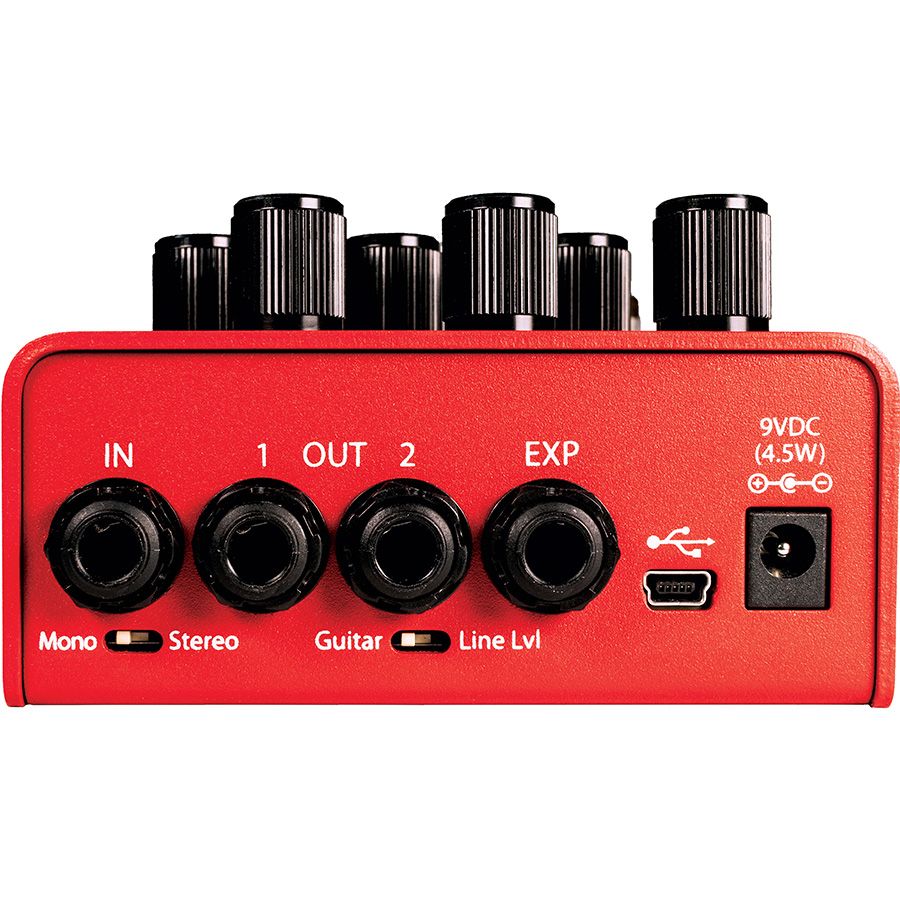
- Guitar/Line switch Rear-panel level matching for guitar, synth, an effects loop or an audio interface.
- Mono/Stereo switch Tells the TRS input whether to read a mono tip signal or a true stereo tip-and-ring pair.
Power and pedalboard compatibility
Runs on a 9V DC center-negative supply through a 5.5 mm / 2.1 mm barrel plug and draws up to 300 mA, so it needs an isolated 300 mA (or higher) output rather than a shared daisy chain. Eventide includes a universal power supply with US, EU, UK, JP and AU adapters. Power comes from the DC jack only; Eventide does not publish battery operation for this pedal. Bypass is selectable between Buffered, Relay, DSP+FX and Kill dry, so you can run relay (true) bypass at the front of a board or keep the buffer and effect tails alive inside an amp loop. A rear Guitar/Line level switch matches the pedal to a guitar, a synth, an effects loop or an audio interface, and a Mono/Stereo switch sets how the TRS input is read.
Technical specifications
| Type | Stereo micro pitch shifting with delay |
|---|---|
| Dimensions | 10.8 x 10.2 x 4.3 cm (L x W x H) |
| Algorithms and presets | Micro pitch shifting with delay; five onboard presets, more over MIDI |
| Audio I/O | Input: 1/4" TRS (mono on tip, stereo on tip and ring). Out 1 and Out 2: 1/4" TS. |
| Control connections | EXP: 1/4" TRS for an expression pedal, an aux switch or MIDI I/O. Mini USB for software updates and MIDI. No 5-pin DIN MIDI and no Bluetooth on this model. |
| Maximum input level | +8 dBu (Guitar) / +14 dBu (Line) |
| Recommended load impedance | 10 kOhm |
| Weight | 480 g |
| Input impedance | 700 kOhm |
| Output impedance | 220 Ohm |
| Current draw | Up to 300 mA |
| Power | 9V DC center negative, 5.5 mm / 2.1 mm barrel, up to 300 mA; supply included |
| Signal path | Digital |
| Bypass | Selectable; relay (true) bypass available |
| Warranty | One year |
Reference: the official Eventide MicroPitch page and the official manual.
FAQ
What is micro pitch shifting? Very small pitch changes, typically a few cents, applied to duplicated copies of your signal. Panned apart and delayed slightly, they read as width and thickness rather than as a pitch effect.
Can MicroPitch do harmonies? It offers major and minor third intervals, so simple harmony is possible, but diatonic harmonising and larger transpositions are PitchFactor territory.
Does it work on vocals? Yes. Eventide lists guitar, vocals, keyboards, drums, strings, brass and winds. Set the rear switch to Line when feeding it from a preamp or interface.
Does MicroPitch have tap tempo? Yes, through an aux switch connected to the EXP jack and assigned to Tap Tempo. There is no dedicated tap footswitch on the pedal itself.
Will a daisy chain power it? Not reliably. It draws up to 300 mA at 9V center negative, so use an isolated output rated 300 mA or more.
How do I get MIDI into it? Over the 1/4" TRS EXP jack with a MIDI-to-TRS cable or converter box, or over Mini USB. There is no 5-pin DIN socket on this pedal.