


About This Item
Description
UltraTap is what happens when you give a delay dozens of tape heads and let you move them: hold a chord and it can bloom into a reverse pad, stutter into a rhythmic pattern or smear into a glitchy reverb that no plate ever made.
Which Eventide delay is this?
UltraTap is not a conventional echo. It builds delays from many taps whose positions and levels you control, which is how it produces rhythmic patterns, reverse swells, pad-like volume ramps and glitchy reverbs. For classic delay voices, tape echo and a looper, use TimeFactor. For gravity-bending ambience use Blackhole. For a single modulated analog-style repeat use Rose. The H9 Harmonizer Gen 2 includes UltraTap among its algorithms if you prefer one box.
Why guitarists choose the UltraTap
- You choose how many taps make up the delay, so the same pedal covers a single repeat, a rhythmic pattern and a dense wash of reflections.
- Spread moves the taps in time, which is the control that turns an even echo into a reverse swell or an accelerating ramp.
- Slurm smears the taps together into reverb-adjacent textures without loading a separate reverb pedal.
- Chop applies rhythmic gating to the tail, so pads become stutters and sustained chords become sequencer-like parts.
- It excels at pad-like volume swells, which is a sound most delay pedals simply cannot make.
- Five onboard presets, expression control and MIDI recall let a subtle doubling and a full ambient collapse coexist in one set.
Controls and switches
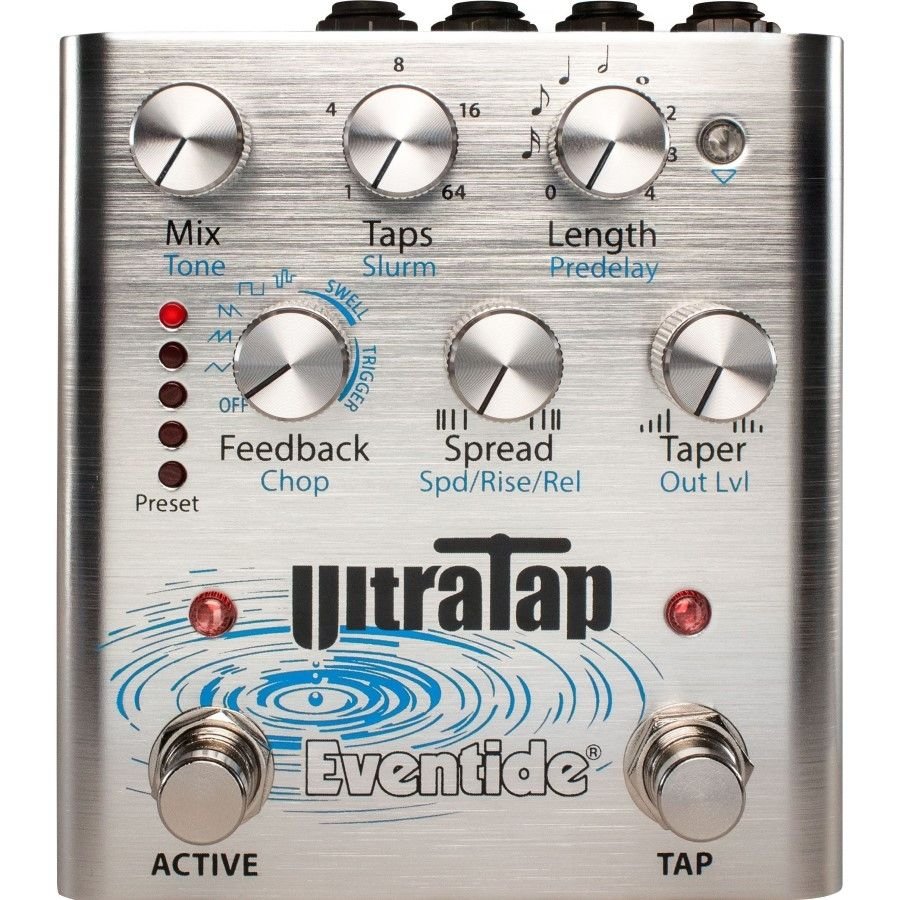
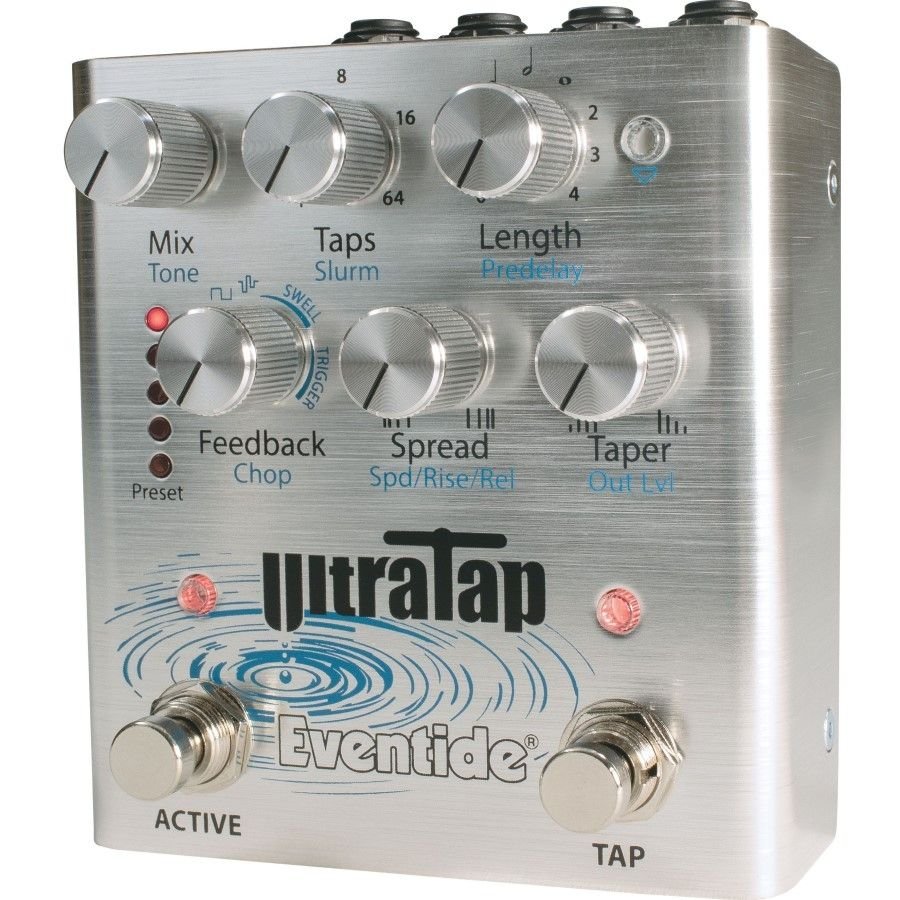
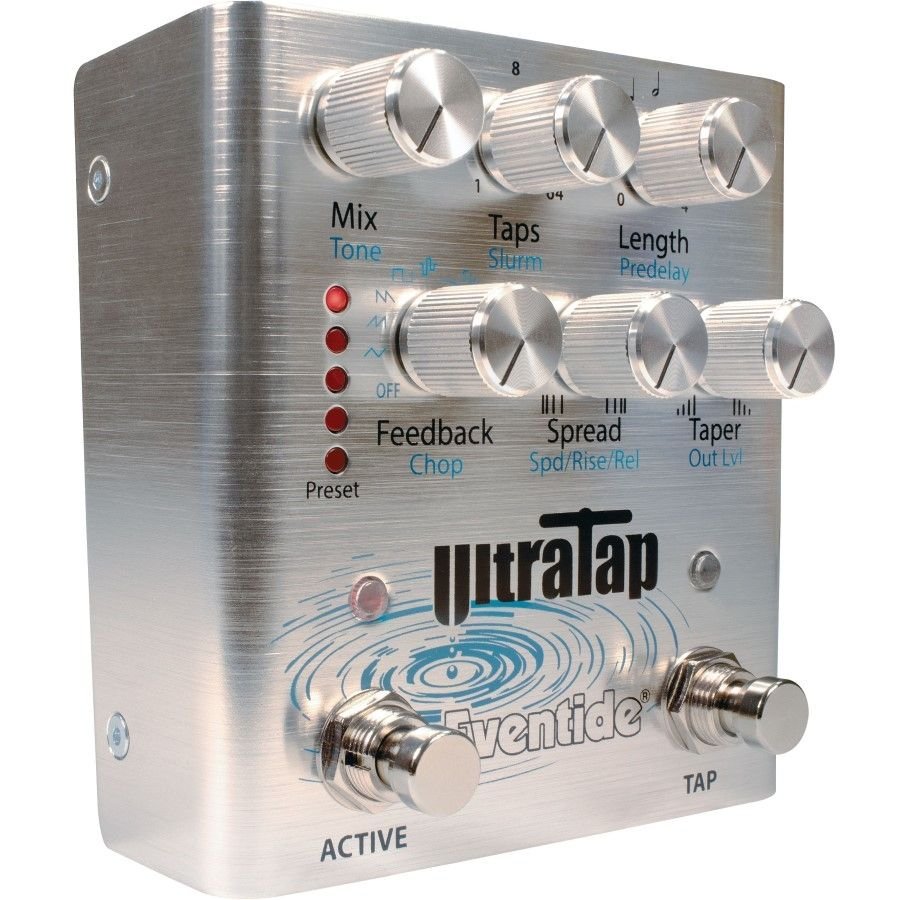
- TAPS Sets how many delay taps are generated, from a single repeat to a dense cluster.
- LENGTH / DELAY Sets the overall time span the taps occupy.
- SPREAD Distributes the taps across that span, producing even, accelerating or reversing patterns.
- FEEDBACK Recirculates the tap cluster for longer, denser trails.
- SLURM Smears and modulates the taps together into reverb-like texture.
- CHOP Rhythmically gates the output for stutters and tremolo-like patterns.
- MIX Balances the tap cluster against the dry signal.
- Active footswitch Engages the effect; dual-action, so it works latching or momentary.
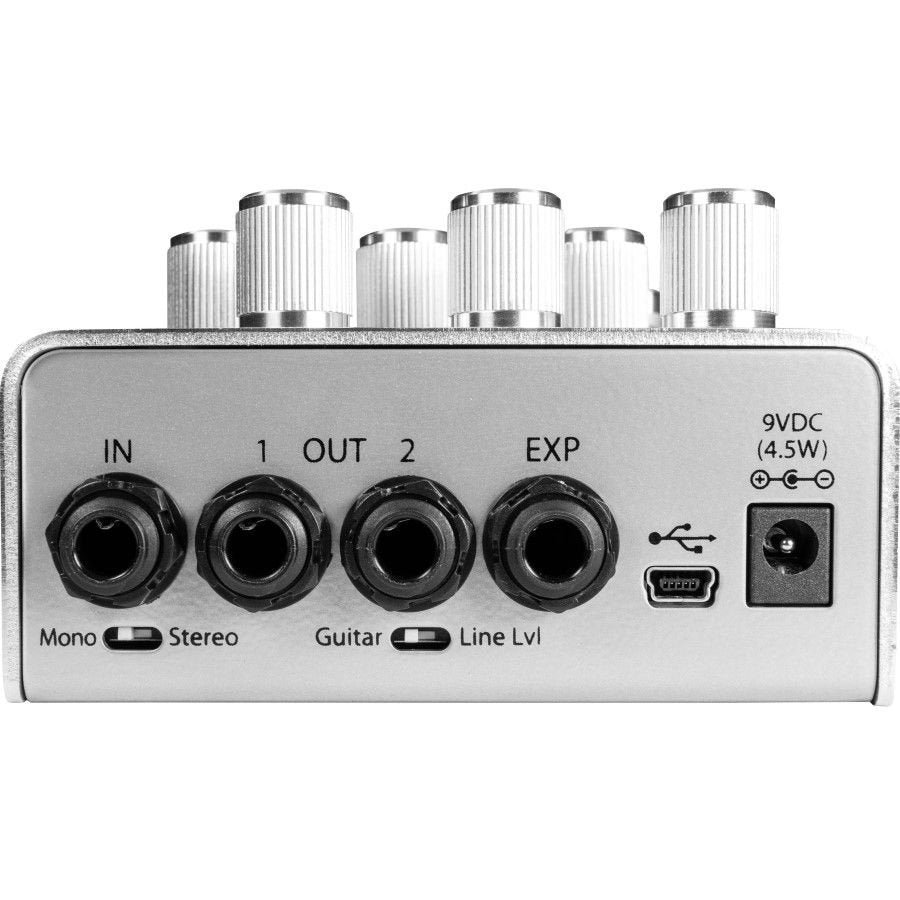
- Guitar/Line switch Rear-panel level matching for guitar, synth, an effects loop or an audio interface.
- Mono/Stereo switch Tells the TRS input whether to read a mono tip signal or a true stereo tip-and-ring pair.
Power and pedalboard compatibility
Runs on a 9V DC center-negative supply through a 5.5 mm / 2.1 mm barrel plug and draws up to 300 mA, so it needs an isolated 300 mA (or higher) output rather than a shared daisy chain. Eventide includes a universal power supply with US, EU, UK, JP and AU adapters. Power comes from the DC jack only; Eventide does not publish battery operation for this pedal. Bypass is selectable between Buffered, Relay, DSP+FX and Kill dry, so you can run relay (true) bypass at the front of a board or keep the buffer and effect tails alive inside an amp loop. A rear Guitar/Line level switch matches the pedal to a guitar, a synth, an effects loop or an audio interface, and a Mono/Stereo switch sets how the TRS input is read.
Technical specifications
| Type | Stereo multi-tap delay and rhythmic effect |
|---|---|
| Dimensions | 10.8 x 10.2 x 4.3 cm (L x W x H) |
| Algorithms and presets | Multi-tap delay engine; five onboard presets, more over MIDI |
| Audio I/O | Input: 1/4" TRS (mono on tip, stereo on tip and ring). Out 1 and Out 2: 1/4" TS. |
| Control connections | EXP: 1/4" TRS for an expression pedal, an aux switch or MIDI I/O. Mini USB for software updates and MIDI. No 5-pin DIN MIDI and no Bluetooth on this model. |
| Maximum input level | +8 dBu (Guitar) / +14 dBu (Line) |
| Recommended load impedance | 10 kOhm |
| Weight | 480 g |
| Input impedance | 700 kOhm |
| Output impedance | 220 Ohm |
| Current draw | Up to 300 mA |
| Power | 9V DC center negative, 5.5 mm / 2.1 mm barrel, up to 300 mA; supply included |
| Signal path | Digital |
| Bypass | Selectable; relay (true) bypass available |
| Warranty | One year |
Reference: the official Eventide UltraTap page and the official manual.
FAQ
What is a multi-tap delay? Rather than one repeat that decays, a multi-tap delay creates several taps at different times and levels. UltraTap lets you set how many there are and where they sit, which is why it can imitate rhythms, swells and reverbs.
Can UltraTap make reverse sounds? Yes. Distributing the taps so their levels ramp upward produces reverse-style swells and pad-like volume ramps.
What does Slurm do? It smears and modulates the taps into each other, moving the sound from discrete echoes towards a glitchy, reverb-like wash.
Does UltraTap have tap tempo? Yes, through an aux switch connected to the EXP jack and assigned to Tap Tempo. There is no dedicated tap footswitch on the pedal itself.
Can I use it in an effects loop? Yes. Set the rear switch to Line and choose the DSP+FX or Buffered bypass mode so tails continue when the effect is switched out.
Will a daisy chain power it? Not reliably. It draws up to 300 mA at 9V center negative, so use an isolated output rated 300 mA or more.