


About This Item
Description
The Meris Mercury7 blends two spacious reverb algorithms with a built-in pitch vector, turning simple chords or single notes into shimmering, off-world ambience.
Which Meris Mercury7 is this?
Mercury7 is the original two-footswitch reverb: two algorithms (Ultraplate and Cathedra), a built-in pitch vector, a Swell footswitch, and no tap-tempo footswitch. If you want six reverb algorithms, a navigation screen, 99 presets across 33 banks, native 5-pin DIN and USB-C MIDI, and a Hold Modifier switch that can be configured for tap-tempo-style control, that is the MercuryX, available separately as its own pedal on our site.
Why guitarists choose the Mercury7
- Two spacious reverb algorithms, Ultraplate and Cathedra, cover bright plate shimmer and dense, otherworldly hall ambience.
- Built-in pitch vector layers shifted octaves and fifths into the reverb tail for shimmering, synth-like ambience.
- Dedicated Swell footswitch creates instant volume-pedal-style crescendos with no extra pedal.
- 16 onboard presets store your favorite reverb and pitch combinations for instant recall.
- Trails-enabled bypass lets the reverb tail decay naturally after you switch off.
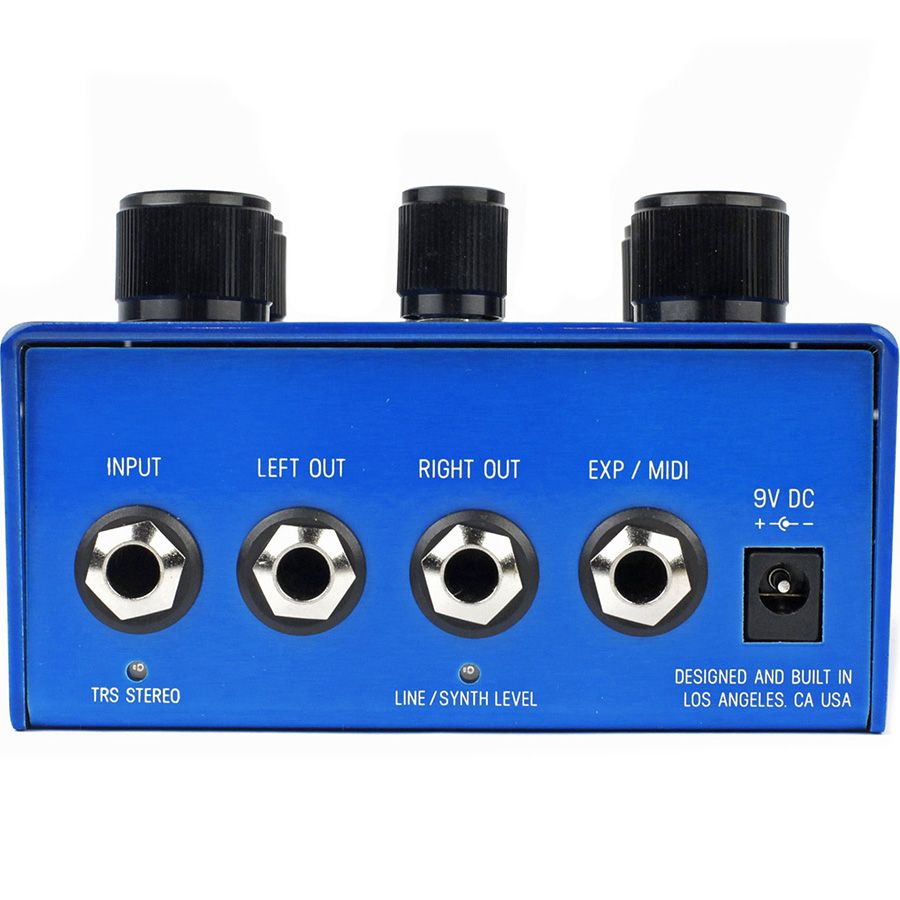
- MIDI over the multi-function EXP jack unlocks full remote control with the Meris MIDI I/O.
Controls and switches
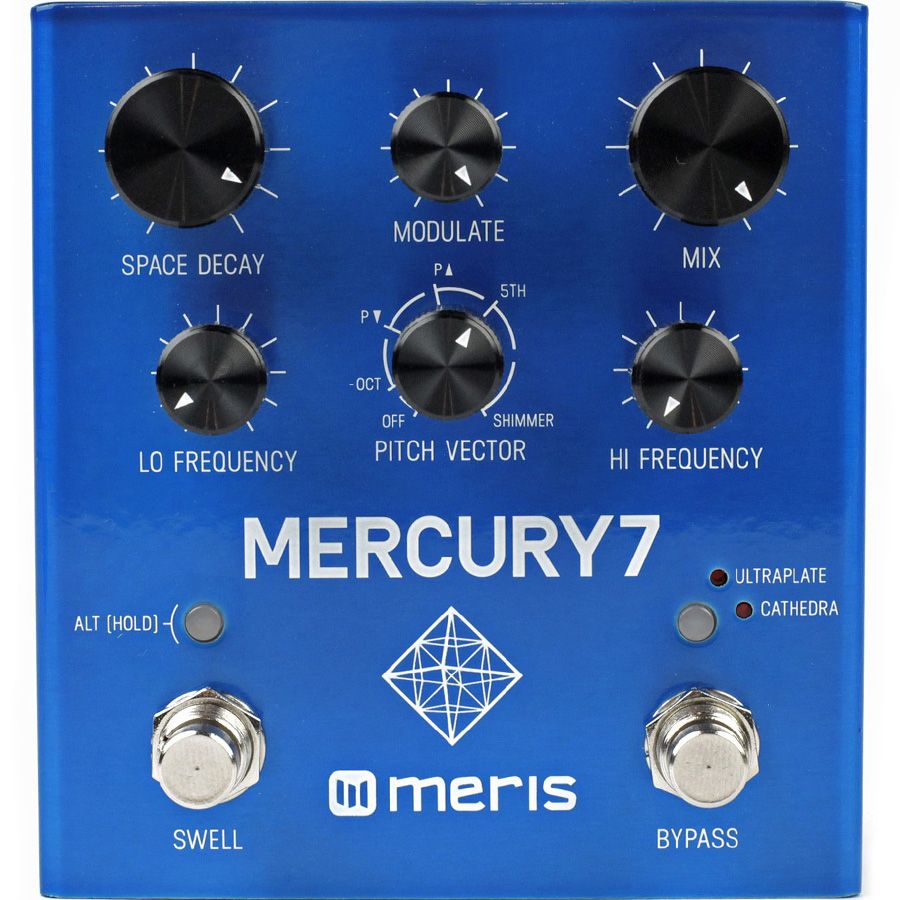
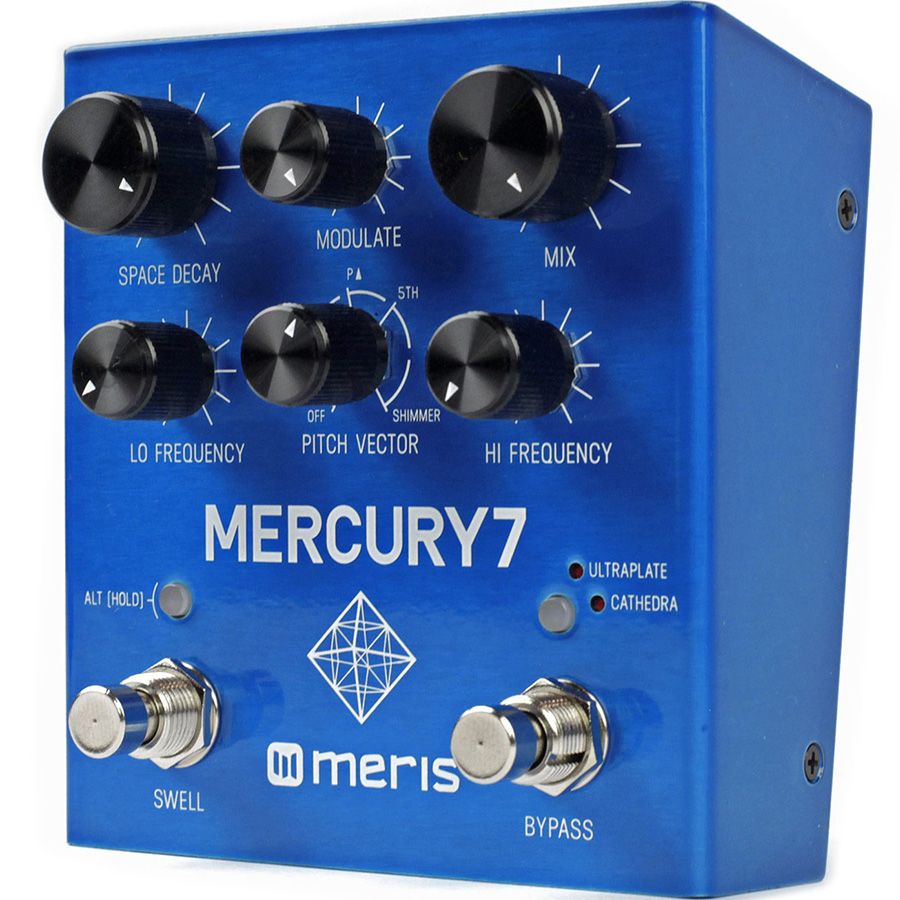
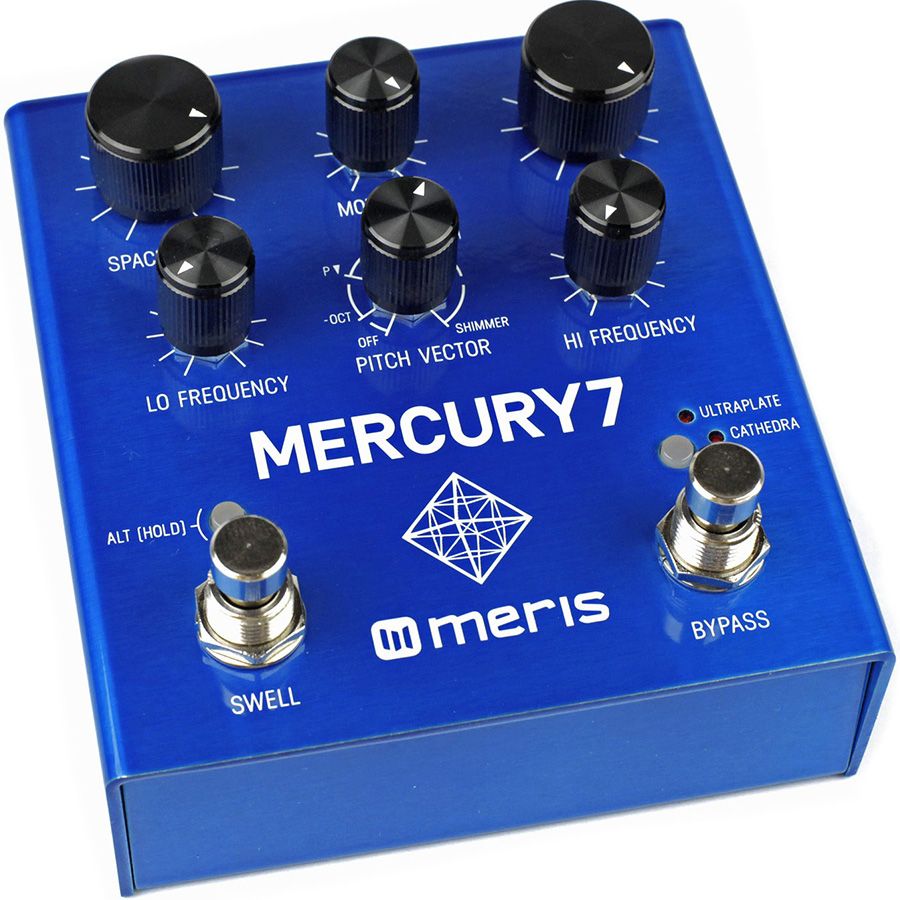
- Space Decay / Predelay (Alt) — Sets how long the reverb tail rings out; Alt sets predelay time before the reverb onset, separating dry attack from the wash.
- Modulate / Mod Speed (Alt) — Controls the depth of internal modulation inside the reverb tank; Alt sets the speed of that modulation for gentle chorusing or faster shimmer.
- Mix / Pitch Vector Mix (Alt) — Blends reverb with your dry signal; Alt sets how much of the built-in pitch-shifted vector is mixed into the reverb tail.
- Lo Freq / Density (Alt) — Shapes low-frequency content in the reverb tail; Alt adjusts reverb density from sparse early reflections to a dense wash.
- Pitch Vector / Attack Time (Alt) — Sets the pitch interval fed into the reverb tank for shimmer effects; Alt sets how quickly the reverb swells in.
- Hi Freq / Vibrato Depth (Alt) — Shapes high-frequency content in the tail; Alt sets vibrato depth applied within the reverb.
- Algorithm select — Chooses between Ultraplate (a dense, smooth plate-style reverb) and Cathedra (a large, cathedral-like hall).
- Swell footswitch — Momentarily swells the reverb in for volume-pedal-style pads, independent of the Bypass footswitch.
- Bypass footswitch — Engages or bypasses the effect.
Power and pedalboard compatibility
Mercury7 runs on 9V DC, center-negative, 2.1 mm barrel, drawing about 150 mA — well within range for a standard isolated pedalboard supply. A power supply is not included. The True Bypass relay is mono, so Mercury7 sits fine anywhere in a standard mono chain; with Trails enabled the reverb tail continues to ring out naturally after bypass, and most players place it last in the chain, after drive, modulation, and delay. For instant preset recall or full MIDI control without a computer, pair it with the Meris Preset Switch and the Meris MIDI I/O.
Technical specifications
| Model | Meris Mercury7 |
| Effect type | Reverb |
| Topology | Digital |
| Bypass | Selectable relay true bypass or analog buffered bypass |
| Input impedance | 1000 kΩ |
| Power | 9 Volt DC, center-negative, 2.1 mm barrel |
| Current draw | 150 mA |
| Expression input | Yes |
| Onboard presets | Yes |
| Tap tempo | No |
| Enclosure dimensions | 11.43 × 10.8 × 5.08 cm |
| Weight | 413.9 g |
| GTIN | 862539000414 |
FAQ
Does Mercury7 have a tap-tempo footswitch?
No. Mercury7's two footswitches are dedicated to Swell and Bypass; there is no dedicated tap-tempo control or MIDI beat-clock sync on this model.
What is the difference between Mercury7 and MercuryX?
Mercury7 has two reverb algorithms and no tap-tempo or screen. The MercuryX adds six reverb algorithms, a navigation screen, 99 presets, native MIDI, and a Hold Modifier switch that can be configured for tap-tempo-style control, and is sold as a separate model on our site.
What do the two algorithms sound like?
Ultraplate is a dense, smooth plate-style reverb; Cathedra is a large, cathedral-like hall reverb.
Can I recall presets without MIDI?
Yes. The first four of Mercury7's 16 presets are reachable with the Meris Preset Switch, and all 16 over MIDI with the Meris MIDI I/O.
Does Mercury7 have trails?
Yes. A global Trails setting lets the reverb tail decay naturally after bypass instead of cutting off.
What power supply does Mercury7 need?
9V DC, center-negative, 2.1 mm barrel, drawing about 150 mA. A power supply is not included.
How do I add MIDI control to Mercury7?
Connect a Meris MIDI I/O to Mercury7's EXP jack with a TRS cable to convert standard 5-pin DIN MIDI.