




About This Item
Description
The Meris Ottobit Jr. crushes your guitar or synth signal down to variable sample rates and bit depths, then sequences the destruction across six steps for chiptune, glitch, and 8-bit textures. Its tagline says it all: audio in, video game out.
Which Meris Ottobit Jr. is this?
Ottobit Jr. is the original compact two-footswitch bitcrusher: variable sample rate and bit crushing, a vintage-synth-inspired resonant low-pass filter, triggered stutter, a 6-step sequencer for pitch, filter, or sample-rate patterns, tap tempo, stereo input and output, and 16 preset locations. The Meris Ottobit X is a separate model.
Why guitarists choose the Ottobit Jr.
- Independent sample-rate (48 Hz – 48 kHz) and bit-depth (1–24 bits) controls dial in everything from subtle grit to full 8-bit collapse.
- 6-step sequencer plays pitch, filter, or sample-rate patterns — once, twice, 4 or 8 times, or continuously — for chiptune-style arpeggios and rhythmic sweeps.
- Triggered stutter repeats slices of your playing in time with the tap tempo; it detects your pick attack and lines it up with the current tempo to keep the stutter musical.
- Tap tempo locks the sequencer and stutter timing to your song; hold the Tap footswitch to freeze the stutter buffer.
- Stereo input and output, with input headroom switchable for guitar, synth or line level.
- 16 preset locations: the first 4 recall from the Meris Preset Switch, all 16 over MIDI.
- MIDI over the multi-function EXP jack unlocks full remote control with the Meris MIDI I/O.
Controls and switches
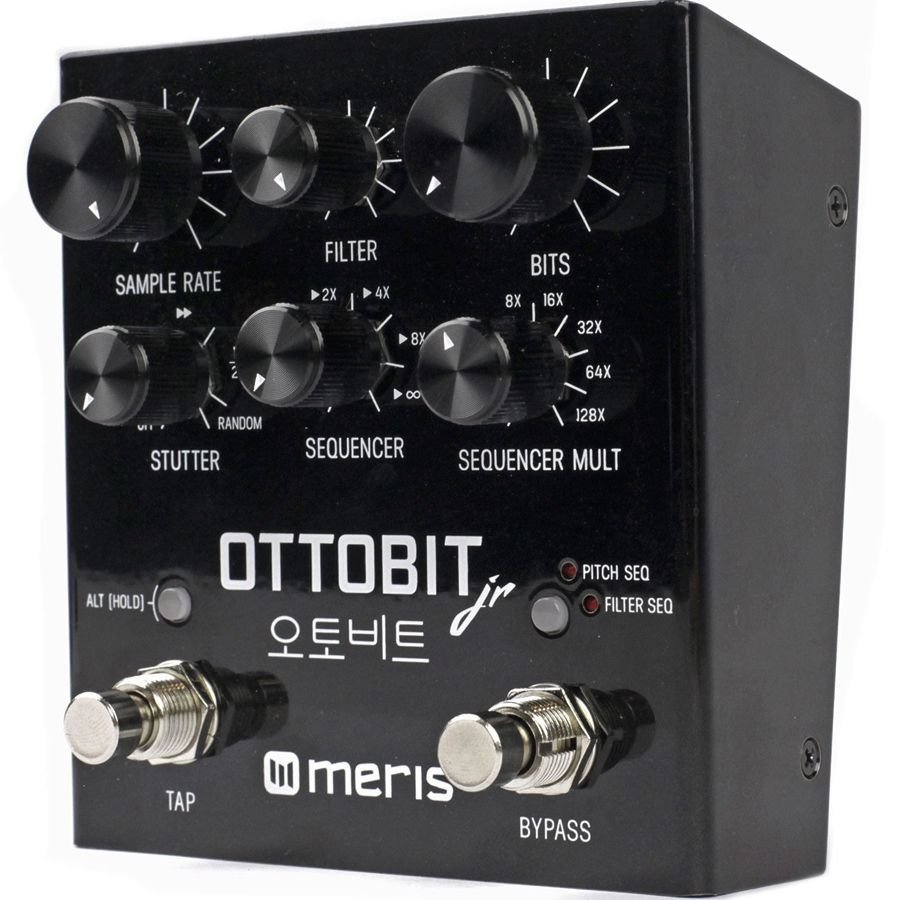
- Sample Rate / Step 1 (Alt) — Sweeps sample rate from 48 Hz to 48 kHz for everything from subtle grit to full digital collapse; Alt sets the value for sequencer Step 1.
- Filter / Step 2 (Alt) — Sweeps the cutoff of the resonant low-pass filter; Alt sets the value for sequencer Step 2.
- Bits / Step 3 (Alt) — Reduces bit depth from 24 bits down to 1 bit for classic crunchy bitcrushing; Alt sets the value for sequencer Step 3.
- Stutter / Step 4 (Alt) — Sets the playback speed and length of the stutter; Alt sets the value for sequencer Step 4.
- Sequencer Play Mode / Step 5 (Alt) — Chooses how the 6-step sequencer plays back — once, twice, 4x, 8x, or continuous; Alt sets the value for sequencer Step 5.
- Sequencer Multiply / Step 6 (Alt) — Sets the sequencer's speed as a multiple of the tapped tempo; Alt sets the value for sequencer Step 6.
- Tap / Alt switch — Its LED blinks at the tap tempo; hold it to reach the Alt layer and program the sequencer steps.
- Bypass / Sequencer Type switch — Selects the sequencer type: two small LEDs show which is active, and with both off the sample-rate sequencer runs.
- Tap footswitch — Taps in the speed and timing of the sequencer and stutter; hold to freeze the stutter buffer for a glitched-out held texture.
- Bypass footswitch — Engages or bypasses the effect.
Connections & Power
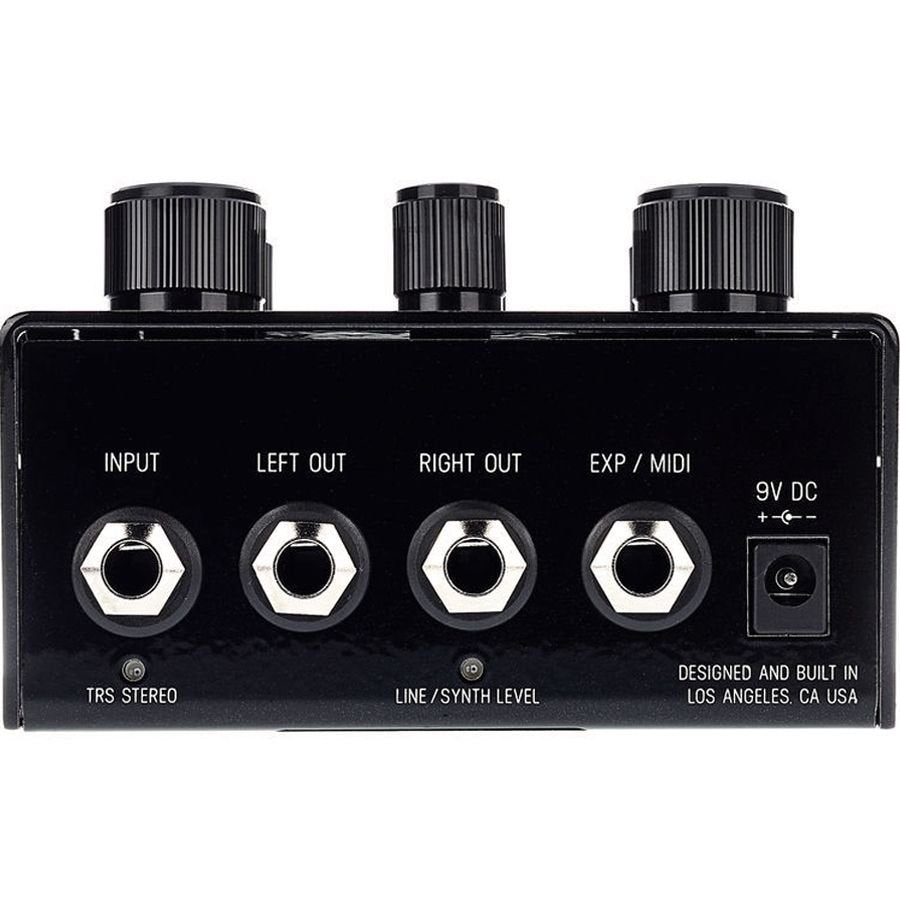
- Input: 1/4" jack, mono or stereo TRS (selected in global settings); outputs: Left and Right 1/4" jacks.
- Instrument or line/synth level setting; Kill Dry option for use in parallel effects loops.
- Multi-function EXP jack: expression pedal (controls all parameters at once), remote tap switch, Meris 4-button Preset Switch, or MIDI In/Out via the Meris MIDI I/O.
- Tempo can be stored per preset or set globally.
- Power: 9V DC center-negative, 2.1 mm barrel, 150 mA. A power supply is not included and battery operation is not supported.
Use a supply output that delivers at least 150 mA. Because Ottobit Jr. fully re-samples the signal, placing it early — right after the guitar or synth and before modulation and time-based effects — lets those effects process the crushed signal; placed after them, it crushes their output instead.
| Model | Meris Ottobit Jr. |
|---|---|
| Effect type | Bitcrusher, stutter, filter and step sequencer |
| Sample rate control | 48 Hz – 48 kHz |
| Bit depth | 1–24 bits |
| Sequencer | 6 steps; pitch, filter or sample-rate; once, twice, 4x, 8x or continuous |
| Topology | Digital (24-bit A/D and D/A, 32-bit floating-point DSP, 48 kHz) with analog dry path |
| Audio I/O | Mono or stereo (TRS) input, stereo L/R outputs |
| Input impedance | 1 MΩ |
| Max input level | +9 dBu (Instrument), +12.5 dBu (Line/Synth) |
| Frequency response | 20 Hz – 20 kHz |
| Signal-to-noise ratio | 110 dB typical |
| Bypass | Selectable relay true bypass or analog buffered bypass |
| Presets | 16 (1–4 via Preset Switch, 1–16 via MIDI) |
| Tap tempo | Yes, footswitch or remote tap switch |
| Expression / MIDI | Multi-function TRS EXP jack (expression, tap, preset switch, MIDI) |
| Power | 9V DC center-negative, 2.1 mm, 150 mA (supply not included) |
| Dimensions | 4.25 × 4.5 × 2 in (108 × 114 × 51 mm) |
| Weight | 14.6 oz (414 g) |
| Made in | Designed and built in California, USA |
FAQ
What is the sample rate range? Adjustable from 48 Hz to 48 kHz, from subtle grit to full digital breakdown.
What bit depths are available? 1 bit to 24 bits.
What can the sequencer control? The 6-step sequencer can be set to pitch, filter, or sample-rate patterns, with play modes of once, twice, 4x, 8x, or continuous; its speed is a multiple of the tap tempo.
How is the stutter triggered? By your playing: Ottobit Jr. detects the pick attack and aligns the stutter with the current tap tempo. Hold the Tap footswitch to freeze the stutter buffer for a held, glitched texture.
Is Ottobit Jr. stereo? Yes. The TRS input can be set to mono or stereo, and there are separate Left and Right outputs.
Can I use it with synths or drum machines? Yes. The input can be set to line/synth level, which raises maximum input to +12.5 dBu.
Can I recall presets without MIDI? Yes. The first four of Ottobit Jr.'s 16 presets are reachable with the Meris Preset Switch, and all 16 over MIDI with the Meris MIDI I/O.
What power supply does Ottobit Jr. need? 9V DC, center-negative, 2.1 mm barrel, 150 mA. A power supply is not included.