


About This Item
Description
A real 12AX7A preamp tube driving two identical channels — the TwinBlaze puts a two-channel tube amp's front end onto your pedalboard, with each channel independently switchable between Crunch and Lead voicings, from British clean to high gain.
What makes the TwinBlaze different from a typical dual-drive pedal?
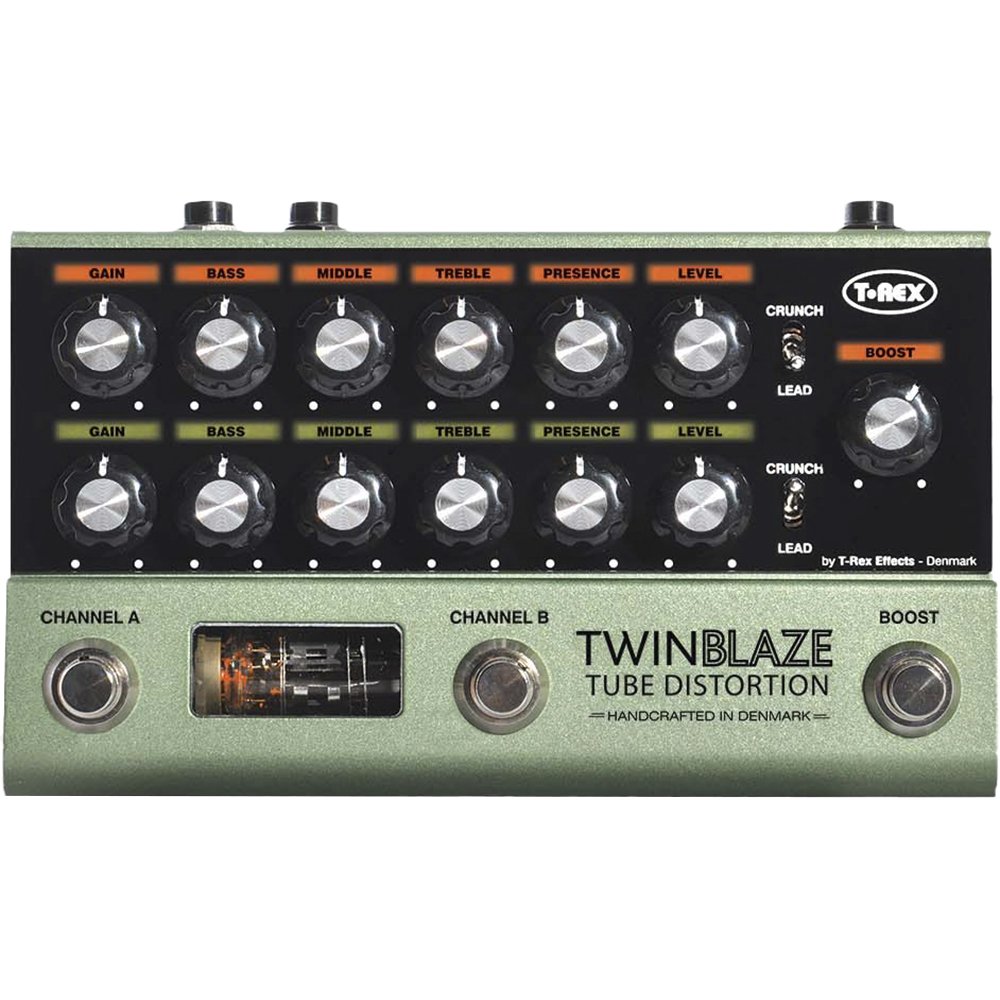
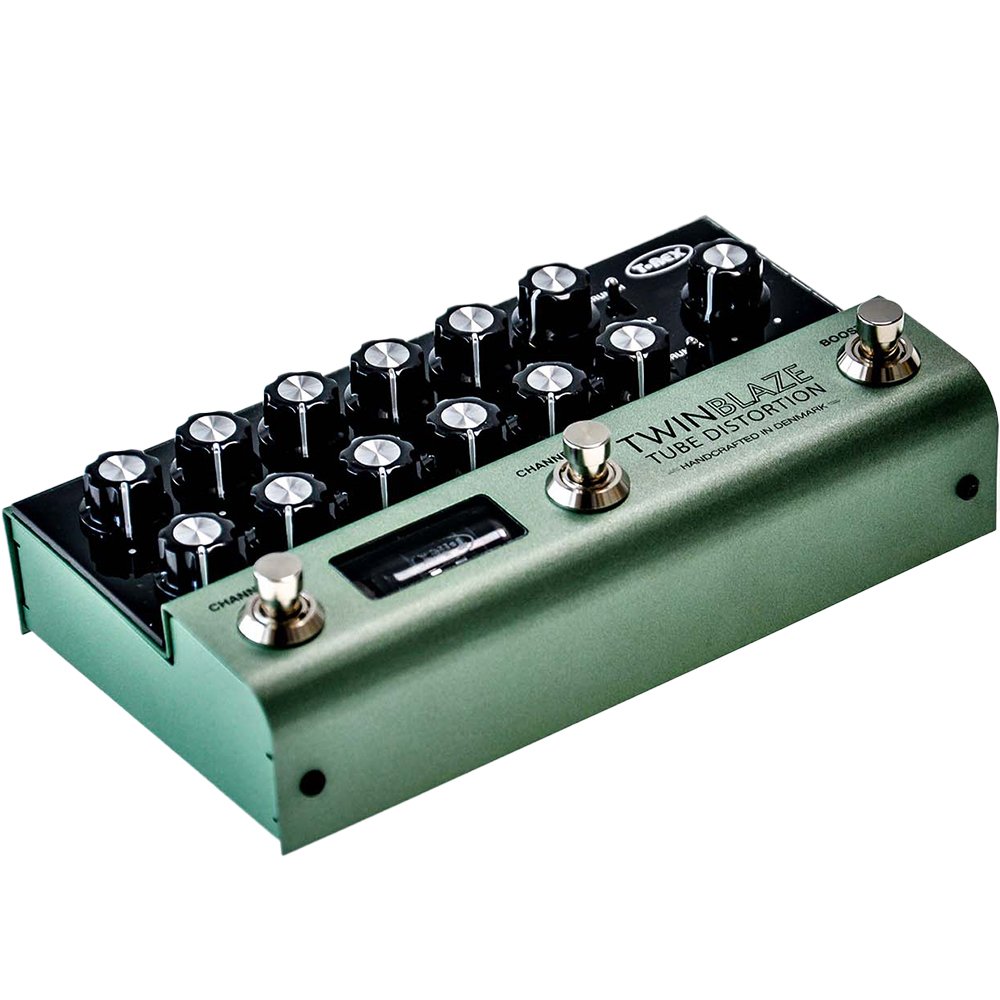
The TwinBlaze runs a 12AX7A (ECC83) dual-triode tube on high voltage — an internal step-up circuit generates 200 V DC for the anodes — with both triode halves cascaded for tube clipping, supported by diode clipping. Two identical channels each have a full six-knob control set (Gain, Bass, Middle, Treble, Presence, Level) and a Crunch/Lead switch — effectively adding two footswitchable tube channels to your existing amp.
Why guitarists choose this pedal
- 12AX7A (ECC83) vacuum tube in the preamp path, running on 200 V DC.
- Two independent channels (A and B), each with a Crunch/Lead voicing switch, giving four core tones on the fly.
- Six controls per channel — Gain, Bass, Middle, Treble, Presence, Level.
- Dedicated 0–20 dB clean boost with its own footswitch, placed after the distortion and usable whether the channels are on or off — great for solos.
- Analog speaker-simulation output for direct-to-interface recording or a feed to the PA.
- Handmade in Denmark.
Controls and switches
- Gain A / B — how hard each channel drives the tube stage.
- Level A / B — output volume per channel (sets rhythm or solo volume).
- Bass, Middle, Treble (per channel) — ±6 dB at 80 Hz, 1.3 kHz and 2.3 kHz.
- Presence (per channel) — shelving control for everything above 2 kHz.
- Crunch/Lead switch (per channel) — voices the channel for crunch or for high-gain lead.
- Boost knob — 0 to 20 dB of clean level lift.
- Channel A footswitch — selects channel A or bypass.
- Channel B footswitch — selects channel B or bypass.
- Boost footswitch — engages the clean boost.
- Backlit control markings show which channel and mode are active; unlit means bypass.
Connections & Power
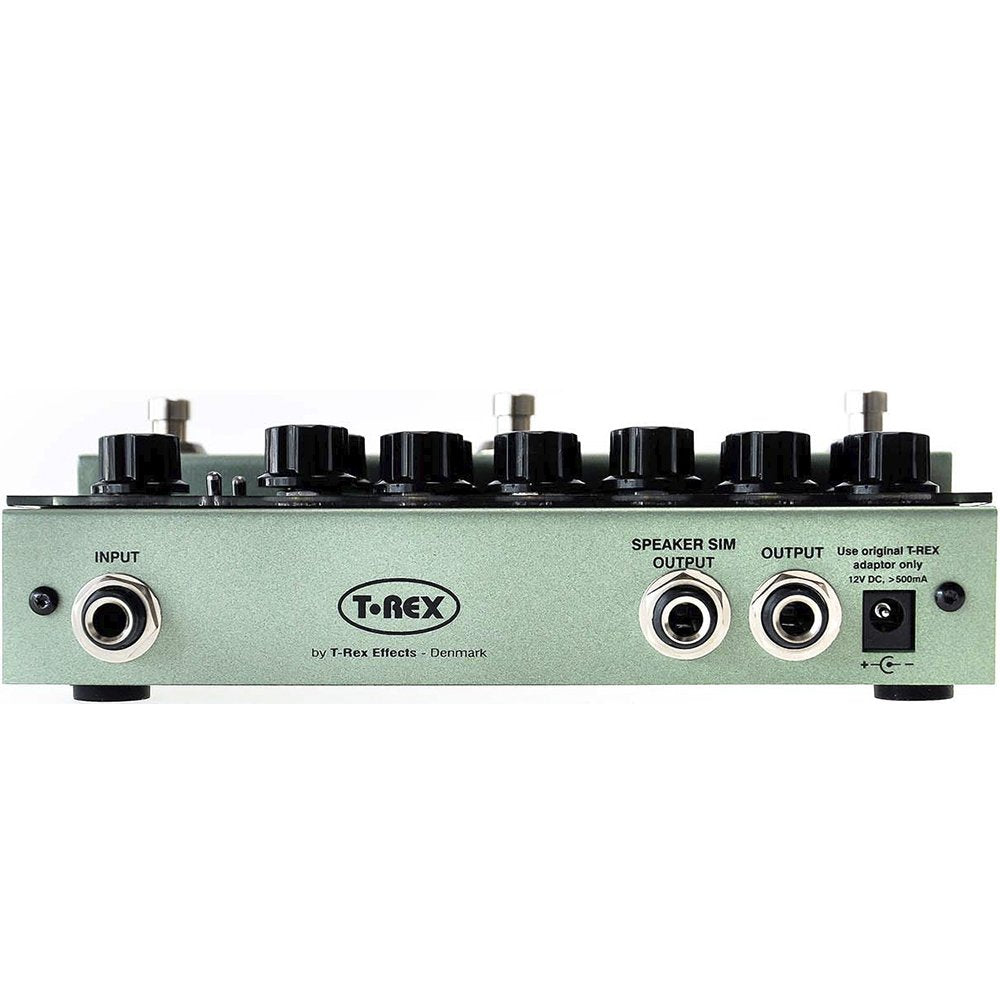
- Top-mounted 1/4" input and 1/4" output.
- 1/4" Speaker Sim output — analog, filter-based cabinet emulation for a mixer or audio interface.
- 12V DC center-negative, 2.1 mm barrel; dedicated power supply included. Use the original T-Rex adapter.
- Current draw 500 mA at 12 V DC — far beyond a typical 100 mA isolated output.
- No battery operation — the high-voltage tube stage requires the external supply.
- Buffered bypass.
Technical specifications
| Model | T-Rex TwinBlaze |
|---|---|
| Effect type | Two-channel tube overdrive / distortion with clean boost and speaker-sim output |
| Tube | 12AX7A (ECC83), 200 V DC internal anode supply |
| Controls | Per channel: Gain, Bass, Middle, Treble, Presence, Level, Crunch/Lead switch; Boost knob |
| EQ range | ±6 dB; Bass 80 Hz, Middle 1.3 kHz, Treble 2.3 kHz, Presence 2 kHz |
| Boost | 0–20 dB, post-distortion |
| Footswitches | 3: Channel A, Channel B, Boost |
| Bypass | Buffered |
| Input impedance | > 1 MΩ (at 1 kHz) |
| Output impedance | < 1 kΩ (at 1 kHz) |
| Jacks | 1/4" input, 1/4" output, 1/4" Speaker Sim out, DC in |
| Power | 12V DC center-negative, 2.1 mm, PSU included |
| Current draw | 500 mA at 12 V DC |
| Dimensions (W × D × H, incl. knobs) | 7.32 × 4.72 × 2.56 in (186 × 120 × 65 mm) |
| Weight | 28.2 oz (800 g) |
| Warranty | 2 years |
| Country of manufacture | Denmark |
FAQ
Is that a real vacuum tube inside? Yes — a genuine 12AX7A (ECC83) preamp tube running on 200 V DC, generated internally by the pedal's power circuit.
How is it different from a solid-state distortion? The tube stage responds to picking dynamics and to your guitar's volume knob more like a tube amp, cleaning up when you back off and saturating when you dig in.
Can I use it as a preamp for silent recording? Yes — the Speaker Sim output feeds an audio interface or mixer directly without a guitar cabinet.
What is the boost voicing? A clean, flat 0–20 dB level lift after the distortion — it does not add tube coloration or change the drive, and it works with the channels on or off.
What power supply do I need? The included 12 V DC, center-negative supply. The pedal draws about 500 mA, so a standard 9 V pedal supply will not work; T-Rex recommends using the original adapter.
How do the footswitches work? Channel A and Channel B each toggle their channel or bypass; the third footswitch turns the boost on and off.
Warranty? 2-year manufacturer warranty.