
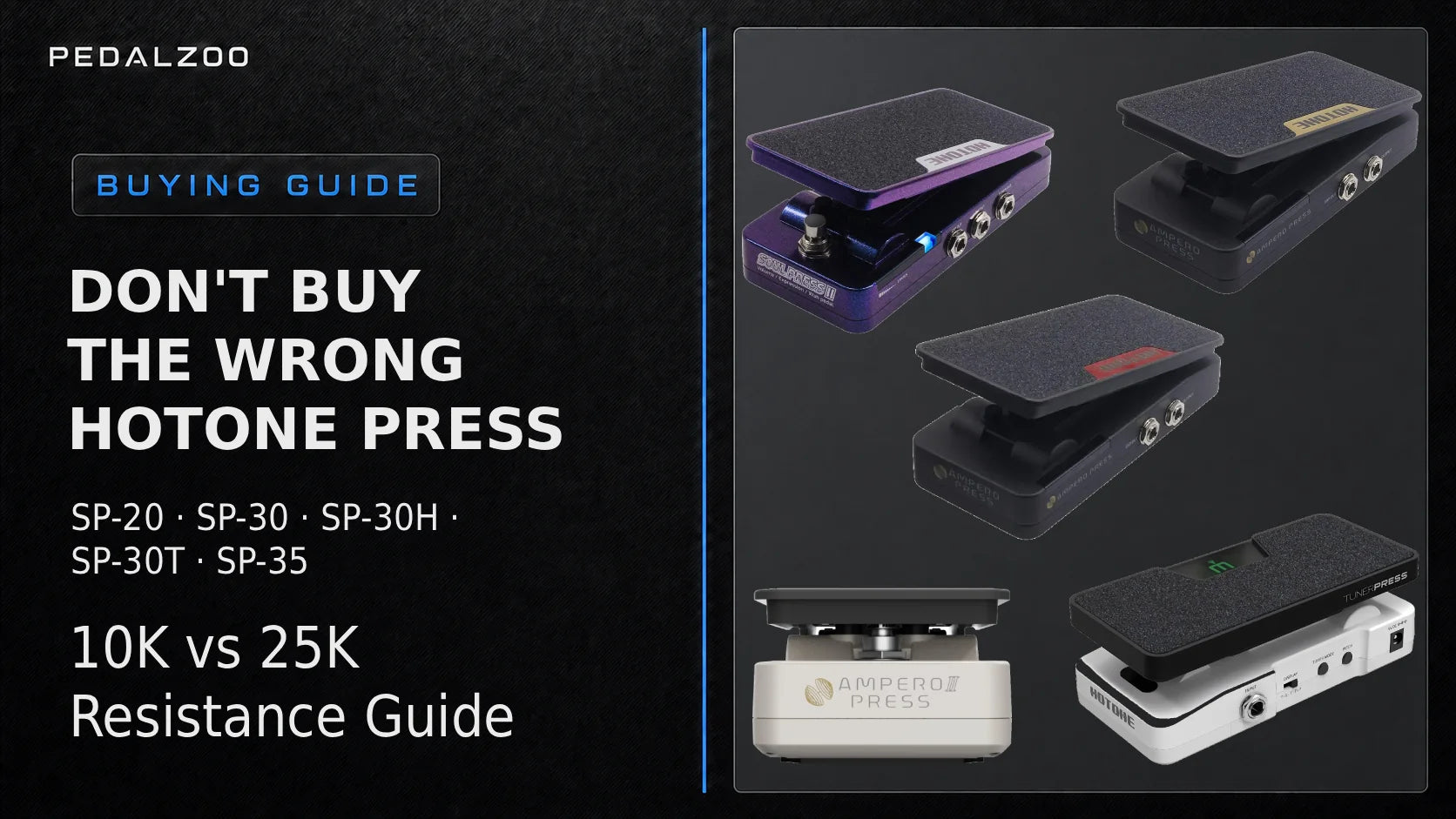
Hotone Press Compatibility Chart: SP-20 vs SP-30 vs SP-30T vs SP-35
Quick Answer: Which Hotone Press Do You Need?
- SP-20 Soul Press II — want wah, active volume, and expression in one pedal. The Soul Press II is the pedal for players who need a real footswitchable wah alongside volume, not just a passive expression controller.
- SP-30 Ampero Press — want a simple, passive volume + expression combo with a 10 kOhm EXP output and no power supply required. See the Ampero Press SP-30.
- SP-30H Ampero Press (25k) — your processor's manual calls for a 25 kOhm expression pedal instead of 10 kOhm. Same body, same passive design, different expression pot — the Ampero Press SP-30H.
- SP-30T Tuner Press — want a tuner, active volume, expression, and a switchable buffer in a single footprint. Check the Tuner Press SP-30T.
- SP-35 Ampero II Press — need expression control plus a separate momentary footswitch, with no audio signal passing through the pedal at all. This is the Ampero II Press SP-35.
SP-35 is not an upgraded SP-30. SP-30 carries an audio signal through INPUT/OUTPUT jacks and controls a 100 kOhm passive volume section. SP-35 has no audio path at all — it only outputs expression and footswitch control signals through two separate jacks.
The Hotone Press Comparison Chart
| Feature | SP-20 | SP-30 | SP-30H | SP-30T | SP-35 |
|---|---|---|---|---|---|
| Primary role | Wah / volume / expression | Passive volume / expression | Passive volume / expression | Tuner / volume / expression / buffer | Expression / momentary footswitch |
| Audio signal path | Yes | Yes | Yes | Yes | No |
| EXP output | TRS, 10 kOhm | TRS, 10 kOhm | TRS, 25 kOhm | TRS, 10 kOhm | TRS, 10 kOhm linear |
| Volume pot | Active | Passive, 100 kOhm | Passive, 100 kOhm | Active | N/A |
| Wah | Warm / Classic, Q control | No | No | No | No |
| Tuner output | Dedicated TUNER OUT | No | No | Built-in LCD tuner, ±0.01 cent | No |
| Buffer | Active circuit | No | No | Switchable, plus HI/LOW impedance switch | No |
| Separate footswitch out | No | No | No | No | Yes, momentary |
| Power | 9V DC or 9V battery, max 30 mA; EXP works unpowered | None — fully passive | None — fully passive | 9V DC only, max 70 mA | None — fully passive |
| Dimensions | 81 x 162 x 51 mm | 81 x 162 x 51 mm | 81 x 162 x 51 mm | 81 x 162 x 61 mm | 81 x 162 x 51 mm |
| Weight | 500 g | 430 g | 430 g | 606 g | 455 g |
All figures come from Hotone's own product pages and owner's manuals.
Note on the Wong Press SP-21: Hotone's Cory Wong signature edition of the Soul Press II carries the identical electrical spec sheet — 10 kOhm EXP OUT, 1 MOhm input impedance, 100 Ohm output impedance, the same Warm (290Hz–1.4kHz) and Classic (360Hz–1.8kHz) wah range selector, and the same 81 x 162 x 51 mm body. The only measurable difference is weight: 512 g versus 500 g for the standard SP-20. Everything in this chart and in the SP-20 section below applies equally to the Wong Press — treat it as the signature-branded version of the same pedal, not a separate compatibility case.
Callout: The TRS Rule
Every Hotone Press EXP output is a 1/4" TRS (Tip-Ring-Sleeve) jack, and it needs a TRS-to-TRS cable to work as an expression controller. Plugging in a standard TS (mono) instrument cable will not transmit the expression signal — owners who try this report the pedal simply doing nothing on the receiving device. SP-35's second output, FOOTSWITCH, is also wired as TRS.
The one documented exception is Line 6. Line 6's own knowledge base states plainly that the Mission EP1-L6 expression pedal for Line 6 gear "connects to the Line 6 device with a single TS cable" and that "TRS cables are not required for Line 6 expression pedals." On Helix and HX Stomp, the TRS wiring on the EXP jack is reserved for connecting two controllers at once (tip = controller 1, ring = controller 2) via a Y-cable, not for a single expression pedal. This distinction matters enough that it gets its own section below.
Which Pot Value Do You Need: 10 kOhm vs 25 kOhm
This is the one place in Hotone's own lineup where the spec sheet actually forks, and it deserves a straight answer rather than a shrug. Four of the five pedals in this chart — SP-20, SP-30, SP-30T, and SP-35 — use a 10 kOhm expression pot. SP-30H is the outlier, built specifically with a 25 kOhm expression section while keeping the same 100 kOhm passive volume circuit as the standard SP-30.
Forum discussion on this topic tends to split into two camps: one insists a device "needs" 25 kOhm to reach its full sweep, the other argues that in most real-world cases the exact potentiometer value barely matters because the receiving device is just reading a voltage divider. Both positions have some truth to them, but neither is a substitute for checking the actual manual of the device you're plugging into.
| Source | Published requirement |
|---|---|
| Hotone Pulze Control (Hotone's own expression accessory) | Maximum expression pedal resistance of 25 kOhm |
| TC Electronic Flashback X4 | Requires a 25 kOhm linear pot; explicitly warns that a standard 250 kOhm logarithmic volume pedal will not work as an expression pedal |
| Kemper PROFILER (all variants) | PEDAL inputs are 1/4" TRS, expression pedal 10 kOhm minimum, 100 kOhm maximum impedance |
| BOSS / Roland (EV-30, EV-5, FV-500 series) | 10 kOhm linear pedals officially specified |
| Line 6 Mission EP1-L6 | 10 kOhm, connected via TS, not TRS |
| Arturia keyboards (general guidance) | Recommends a 10–25 kOhm window; below 10 kOhm risks not reaching maximum value, above 25 kOhm narrows the usable travel range |
Reading across these sources, the pattern is consistent: 10 kOhm is the de facto standard for BOSS, Roland, and Line 6 gear, and it also sits at Kemper's documented minimum. 25 kOhm shows up specifically where a manufacturer (TC Electronic, or Hotone's own Pulze Control) has published that exact number as a requirement. The forum argument about voltage dividers explains why many devices tolerate either value without complaint — but where a manufacturer publishes a number, that number should decide which Press model to buy. If your device's manual is silent on kOhm entirely, a 10 kOhm Press is the reasonable starting point; if it explicitly asks for 25 kOhm, or names the Pulze Control's compatibility ceiling, reach for the SP-30H.
Compatibility by Device Type
Rather than trying to map every brand on the market, it's more reliable to sort by what kind of control input the receiving device actually has.
| What the device has | Practical conclusion |
|---|---|
| A single TRS EXP input | Expression from SP-20, SP-30, SP-30H, SP-30T, or SP-35 is a candidate. Confirm the pot value and calibrate on first connection. |
| A single configurable EXP/CTRL input (switchable between EXP and footswitch modes) | The input can carry expression or a footswitch signal, but generally not both at once — check how the menu assigns that jack. |
| Two independent EXP/CTRL inputs | SP-35's full two-cable scenario (EXP into one jack, FOOTSWITCH into the other) becomes realistic. |
| Only a TS expression input | A direct TRS-to-TRS Hotone cable is not guaranteed to work correctly; a custom TRS-to-TS wiring, or a device with the Line 6-style single-TS convention, may be required. |
| An audio input but no EXP/CTRL jack at all | SP-20, SP-30, SP-30H, and SP-30T can still be used for their audio-path functions (volume, wah, tuning); external parameter control is simply not possible. |
| No audio I/O and no EXP input | None of the five pedals have anywhere to connect. |
Verified Compatibility with Hotone Processors
Hotone's own processor line gives the clearest, best-documented compatibility picture, since the company explicitly names its own Press pedals as intended accessories.
Ampero Mini
Ampero Mini has a single combined 1/4" TRS EXP/CTRL input. Hotone's own manual names the Ampero Press as a fitting controller for this input, and the jack can be configured to act either as an expression input or as a footswitch input. SP-20, SP-30, SP-30H, and SP-30T can all be used here in expression mode; SP-30H should only be used after confirming the current manual and firmware still document 25 kOhm support, since no unverified firmware-specific claims are made here.
Ampero II Stomp
Ampero II Stomp also has one EXP/CTRL jack, but it can be reconfigured in software between EXP, Single FS, and Dual FS modes. Standard expression from any of the 10 kOhm Press pedals works once the input is set to EXP mode. SP-35's full two-output scenario (expression plus an independent momentary footswitch working simultaneously) is not supported through this single jack — only one function at a time.
Ampero II Stage
Ampero II Stage is the most generously equipped of the four, with two EXP/CTRL inputs, and Hotone directly names the Ampero II Press as a matching controller for it. In the documented wiring, EXP and FOOTSWITCH connect to separate ports on the Stage's EXP/CTRL section, making this the cleanest, most explicitly supported scenario for SP-35's dual-jack design across the whole Hotone lineup. This is also the pairing behind Hotone's own bundled MP-380 + SP-35 sets.
Ampero II MP-350
MP-350 already includes a built-in expression/volume pedal on the unit itself, plus a separate external EXP/CTRL input for an accessory pedal. An external Press pedal makes sense here when a player wants a second, simultaneously available parameter or footswitch function rather than replacing the onboard pedal. The exact number and mode options of the external jack should be confirmed against the current official MP-350 manual before assuming a full two-cable SP-35 setup is supported.
Line 6, BOSS, and Kemper: What the Manuals Actually Say
None of these three manufacturers has certified a Hotone Press pedal by name. What follows is a comparison of each brand's own published expression-pedal requirements against Hotone's spec sheet — not a compatibility guarantee.
Line 6 Helix / HX
Line 6's documentation is the one place where the "always TRS" assumption breaks. The Mission EP1-L6, Line 6's own recommended expression pedal, connects with a single TS cable, and Line 6's knowledge base states outright that TRS cables are not required for their expression pedals. On HX Stomp and Helix, the TRS wiring on the combined EXP/FS jack is used for connecting two separate controllers via a Y-cable (tip and ring carrying two independent signals) rather than for a single stereo expression pedal.
Practically, this means a straight TRS-to-TRS cable from a Hotone Press into a Helix or HX device is not guaranteed to sweep correctly out of the box. One documented workaround exists: a Helix Rack owner reported that an SP-30 worked correctly after using a cable wired tip-to-tip and sleeve-to-sleeve, with the ring conductor left disconnected.
Owner report: "Just take TRS jacks and wire Tip to Tip and Sleeve to Sleeve. Let the Rings unwired. It works perfectly with my Helix Rack." This is a single user-reported workaround, not an official Hotone or Line 6 compatibility statement, and it should be treated accordingly.
BOSS
Some BOSS devices use a TRS expression connection and BOSS's own EV-30 dual expression pedal is rated at 10 kOhm with a stereo TRS cable included. However, BOSS's manual for the GT-1000CORE names specific approved models — EV-30, EV-5, FV-500L/H — and warns: "Use only the specified expression pedal. By connecting any other expression pedals, you risk causing malfunction and/or damage to the unit." That warning is a real constraint, not boilerplate, and it means a blanket "Hotone Press works with BOSS" claim would be irresponsible. Check the specific BOSS product's manual before connecting a Hotone Press to it.
Kemper PROFILER
Kemper is the most explicitly documented of the three. Kemper's official technical specifications state that its PEDAL inputs are 1/4" TRS, rated for expression pedals between 10 kOhm minimum and 100 kOhm maximum impedance — a range that comfortably covers both the 10 kOhm and 25 kOhm Hotone Press models. Kemper's main manual adds that an expression pedal "only needs one cable with a stereo jack (TRS jack)" and that "in principle, all kinds and makes of expression pedals can be used." After connecting, Kemper requires assigning the desired function (for example, Wah Pedal) on the corresponding Pedal page, then holding Calibrate while sweeping the pedal fully from heel to toe.
Kemper's own accessory, the Mission EP1-KP switching expression pedal for the PROFILER, is built around a 10 kOhm linear potentiometer paired with a TS momentary switch — architecturally very close to what SP-35 offers with its separate EXP and FOOTSWITCH outputs. That parallel makes Kemper a logical device to pair with SP-35, even though Hotone is not named directly in Kemper's documentation.
A polarity note worth knowing
BOSS's EV-30 includes a physical POLARITY switch, and EHX's Dual Expression pedal has a TRS +/- button that explicitly reassigns which conductor (tip or ring) carries the wiper signal. None of the Hotone Press pedals have an equivalent switch — their TRS wiring is fixed at the factory. If a sweep comes out reversed (100% at heel, 0% at toe), the fix has to happen on the receiving device, not on the Hotone pedal. Helix has a global EXP Polarity setting for exactly this situation, and Kemper offers Pedal Type 1 / Type 2 modes for the same purpose.
Setup, Calibration, and Troubleshooting
- Check the receiving device's manual for the exact input type: dedicated EXP, combined EXP/CTRL, or PEDAL.
- Confirm the required pot value and any specific pedal models the manufacturer names.
- Confirm the correct cable: TRS for nearly all Hotone Press connections, with Line 6's single-pedal TS convention as the documented exception.
- Connect while the receiving device is powered off where the manual recommends it — Line 6 explicitly advises this for HX Stomp's EXP/FS jack, to avoid disturbing the current footswitch assignment.
- Set the combined jack (if applicable) to EXP mode before assigning a parameter.
- Assign the parameter or block you want the pedal to control.
- Run the device's calibration routine, sweeping the pedal fully from heel to toe.
- Check the direction of the sweep matches your expectation.
- If the response is reversed, change the polarity/type setting on the receiving device rather than modifying the Hotone cable.
- If the sweep only covers part of the range, recalibrate first, then double-check pot value and wiring before assuming a fault.
| Problem | Likely cause |
|---|---|
| No response at all | Wrong jack mode selected, wrong cable type (TS instead of TRS), or EXP function not assigned in the patch |
| Only reads 0% or 100%, nothing between | Wiring mismatch — common with TRS pedals plugged into TS-expecting inputs |
| Partial sweep range | Calibration not run, or a pot-value/impedance mismatch with the device's published range |
| Sweep direction is reversed | Opposite polarity — adjust in the receiving device's global or pedal settings, since Hotone Press has no physical polarity switch |
| SP-35 expression works but footswitch does not (or vice versa) | Second output not connected, or the receiving input isn't configured for dual/momentary switch mode |
| SP-20 wah or active volume is silent | Active audio functions require 9V power; passive expression-only use does not |
| SP-30T tuner display or screen is off | SP-30T requires an external 9V DC supply — it has no battery option, unlike SP-20 |
Power and Board Space
SP-30T is the outlier for power and footprint: it requires a 9V DC adapter (no battery option) and draws up to 70 mA, and its 61 mm height and 606 g weight are noticeably larger than the rest of the lineup. SP-20 can run its expression function entirely unpowered, and only needs 9V or a 9V battery for its active volume and wah circuits, drawing a maximum of 30 mA. SP-30 and SP-30H need no power at all — both are fully passive designs. SP-35 is likewise passive, with no power requirement, despite outputting two independent control signals.
FAQ
Is the Wong Press SP-21 different from the Soul Press II SP-20?
Electrically, no — identical EXP output, impedance, and wah range. The differences are Hotone's stated custom volume curve, adjusted wah Q range, and a 12 g weight difference, all tuned for Cory Wong's signature specifications.
Should I buy SP-30 or SP-30H?
Buy SP-30 by default. Only choose SP-30H if your target device's manual specifically calls for a 25 kOhm expression pedal, such as devices compatible with Hotone's own Pulze Control or TC Electronic's Flashback X4.
Does SP-35 replace SP-30?
No. SP-30 is an audio-path passive volume/expression pedal; SP-35 has no audio path and exists purely as an expression-plus-footswitch controller.
Do I need a TRS or TS cable?
TRS for virtually every connection covered in this chart. The one confirmed exception is Line 6 gear using the Mission EP1-L6 convention, which uses TS.
Will a Hotone Press work with Line 6 Helix or HX Stomp?
Not guaranteed out of the box with a straight TRS-to-TRS cable. One Helix Rack owner reported success using a cable wired tip-to-tip and sleeve-to-sleeve with the ring left disconnected — treat this as a workaround, not an official compatibility statement.
Can I connect a Hotone Press to a BOSS processor?
Only after checking that specific BOSS product's manual. Some BOSS units name approved expression pedal models explicitly and warn against using unapproved ones.
Does a Hotone Press work with Kemper PROFILER?
Kemper's published spec (10 kOhm–100 kOhm) comfortably covers both 10 kOhm and 25 kOhm Hotone Press models, and the connection method matches Kemper's documented TRS expression workflow. Calibration on the PROFILER is still required.
Why doesn't my pedal cover the full parameter range?
Usually a calibration or pot-value mismatch. Recalibrate on the receiving device first, then confirm the expression pot value matches what that device expects.
Final Buying Guide
- Choose SP-20 for a standard multifunction wah pedal with active volume and expression, or its Wong Press twin for the same spec in Cory Wong's signature configuration.
- Choose SP-30 for simple, passive 10 kOhm volume plus expression control.
- Choose SP-30H when your receiving device explicitly requires or recommends 25 kOhm.
- Choose SP-30T when you want a tuner and a switchable buffer consolidated with volume and expression in one unit.
- Choose SP-35 when you need expression and a separate footswitch command, and your device has the inputs to support both.
Browse the full Hotone collection for these and other Press-series pedals.