
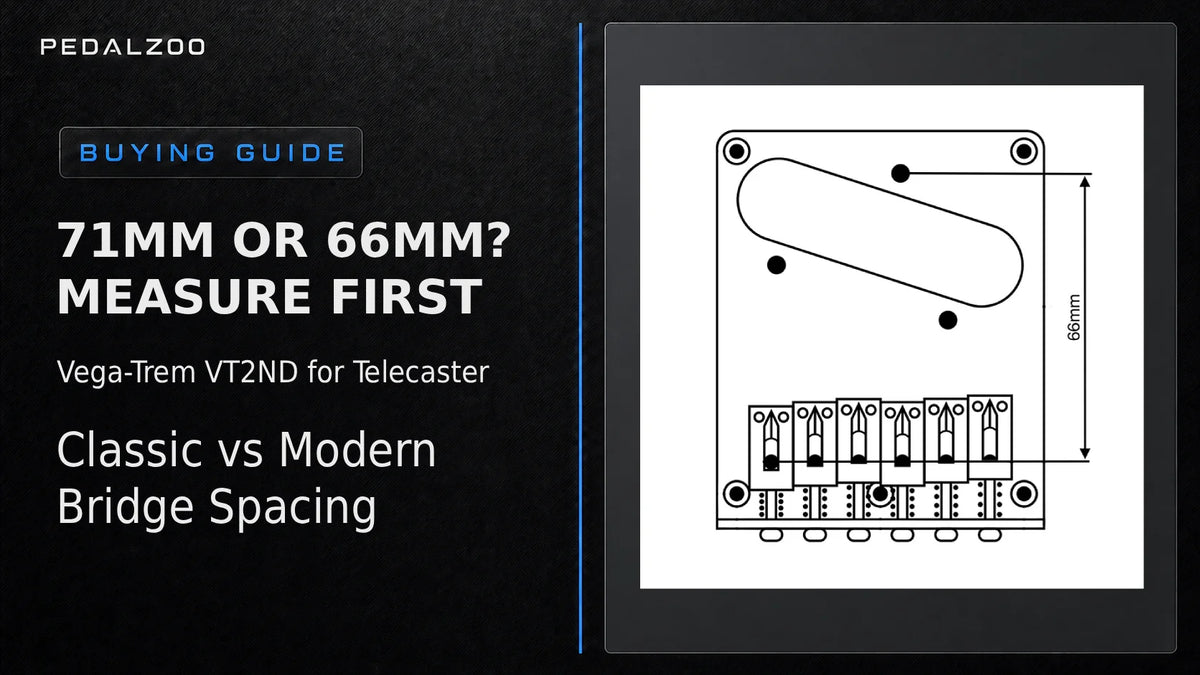
Vega-Trem VT2 / VT2ND for Telecaster: Classic 71mm vs Modern 66mm
A fitment guide for adding vibrato to a T-style guitar without ruining a good bridge decision — plus the honest limitations nobody puts on the product page.
Measure from your string-through holes to the top mounting screw of the bridge pickup. 71mm = Classic. 66mm = Modern. That single number decides which model bolts on — nothing else about your Telecaster matters for fitment.
Then pick the line: the current production model is the VT2ND, which mounts using your guitar's existing factory holes and needs no drilling. The original VT2 required two new holes and has been discontinued — if you see it listed anywhere, it's old stock.
Why this measurement exists
Telecaster bridges were never standardized the way most people assume. Fender's vintage three-saddle bridge and the later six-saddle "modern" bridge use different distances between the string ferrules and the bridge pickup's mounting screws. Vega-Trem builds two separate bridge plates — one for each spacing — because the plate has to line up with your existing screw holes exactly.
This is also the single most common way people order the wrong bridge. Guitarists measure screw-to-screw, or eyeball it, or assume "modern" means anything after 1990. None of that is right. The only measurement that matters is string-through hole to the top screw of the bridge pickup, and it's worth getting a caliper on it rather than a tape measure.
Remove your strings and look at the bridge plate from above. Find the string-through hole for either the low E or high E string, then measure straight down the plate to the top mounting screw of the bridge pickup (the screw closest to the neck). If that distance is close to 71mm, you have classic spacing. If it's close to 66mm, you have modern spacing. Vintage-style American and Mexican-made Telecasters almost always measure 71mm; most Squier and many newer American Telecasters measure 66mm — but don't assume, measure.
What Classic vs Modern actually looks like
Both bridge plates carry the same fit diagram directly on the product photo, showing exactly where the 71mm or 66mm measurement is taken from — it's worth comparing your own bridge against these before ordering.


VT2 vs VT2ND: only one of these is still made
Before Classic-vs-Modern, there's a more basic fork that older threads and used listings will confuse you about. Vega-Trem originally released the VT2 Teletrem, which sits on the same footprint as your stock bridge but requires drilling two small new holes for the mounting screws. It's fully reversible — the two holes end up hidden under the original bridge if you ever revert — but it is a permanent modification to the guitar.
The VT2ND ("No Drill") replaced it as the current production model. It mounts using only the factory holes already in your guitar — the same holes your stock bridge uses to route strings through the body — with zero new holes and zero routing. Vega-Trem's own materials describe this directly as the model that lets you avoid "even the slightest permanent modification."
It's not just the drilling. The VT2ND also introduced a patented saddle design — six saddles working in three brass pairs, but each saddle moves independently for intonation. The original VT2 didn't have this. So the newer model is both less invasive to install and more accurate to set up. There's no real reason to seek out the discontinued VT2 unless you find secondhand stock at a steep discount and don't mind drilling.
The saddle story: why this fixes an old Telecaster compromise
Vintage three-barrel Tele bridges have a well-known trade-off: two strings share each brass saddle, which gives that classic Tele twang and resonance but makes precise intonation for both strings on a shared saddle nearly impossible. Six-saddle modern bridges fixed intonation but changed the tone people associate with the original design.
The VT2ND's patented saddle design tries to have both. It keeps six brass saddles working in three visual pairs — so it still reads as a classic three-saddle-style bridge and keeps the tonal character — but each of the six saddles adjusts independently. You get accurate per-string intonation without giving up the vintage saddle mass and brass contact that shapes the tone.
Before you buy: three things the spec sheet won't tell you
You need a string-through body
This is a hard requirement, not a preference. The VT2ND's springs live inside the six existing string-ferrule holes that run through your guitar's body. If your Telecaster has a top-load bridge (common on some Squier models and budget builds), there's no cavity for the springs to sit in, and the system won't install without drilling new holes — which defeats the entire no-drill premise. Confirm your guitar is string-through before ordering.
A small number of owners with unusually thick guitar bodies (around 45mm, thicker than a standard Telecaster) have reported needing to run spring tension near maximum with heavier string gauges (10-52) to get comfortable resistance. It's not a common complaint, but if your body is on the thick side and you're running heavy strings, budget a little extra patience for spring setup.
Partscasters and non-factory bodies: check hole alignment first
"No drilling required" assumes your factory holes were drilled correctly and in the right positions to begin with. Owners installing on partscaster or hybrid Tele/Strat bodies have occasionally run into mounting screws that won't sit straight because the existing holes were routed slightly off-spec. If you're working with anything other than a standard factory Telecaster body, dry-fit the bridge plate before committing to final installation.
The range is real, but it's not a Floyd Rose
Independent reviewers measured roughly a half-step of upward pitch bend in the VT2ND's standard configuration — modest compared to a locking tremolo, and something players used to deep upward dives should know going in. Where it earns its keep is on the downward side: you can push well past a half-step down into genuine dive-bomb territory, which is the party trick nobody expects from a Telecaster. Multiple long-term owners describe the overall feel as closer to a Bigsby than a Strat-style tremolo — smooth, musical, and vibrato-first rather than a shred-trem substitute.
If you're picturing whammy-bar dive bombs and pull-ups in equal measure, adjust that mental model. Think "expressive vibrato with a genuine dive-bomb option," not "symmetrical high-performance trem." That's exactly what it's built to be, and owners who buy it for that reason tend to love it.
Setup and intonation: the full troubleshooting block
Getting intonation right on the VT2ND takes a slightly different technique than a standard bridge, and it trips people up because the instructions aren't intuitive on first read.
- Loosen the locking screw on the saddle using the 2.5mm Allen key before attempting any adjustment.
- Press the tremolo bar down to lift the bridge plate slightly — this relieves tension on the saddle so it can actually move.
- While still holding the bar down, use the 1.5mm Allen key to slide the saddle forward or back to the correct intonation point.
- Release the bar and re-lock the saddle screw, then retune and recheck at the 12th fret as usual.
If you skip step 2 and try to move the saddle under full string tension, it will feel stuck — that's the most common "my saddles won't move" complaint in forum threads, and it's almost always a technique issue rather than a defect.
Occasionally a saddle reaches the end of its travel before intonation is correct — this shows up more on guitars with slightly non-standard scale length or after a nut/fret job changes the calculation. Vega-Trem's own support response to this is to order longer 20mm saddles individually as replacements for the standard ones, rather than trying to force the stock saddle further than it's designed to go.
It's also worth lubricating your nut slots (a dab of graphite or a lithium-based lubricant) when you install any Vega-Trem system. A vibrato bridge only stays in tune as well as the nut lets the strings slide back afterward — the smoothest bridge in the world can't compensate for strings binding at the nut.
Finish and logo options
Once you've settled on Classic or Modern spacing, the remaining choice is cosmetic. Both spacings are available in a plain steel finish (no color suffix — this is the standard finish, not to be called "chrome") and in Gold. The tremolo arm is available with or without the Vega-Trem logo stamped into it, purely a look preference with no functional difference. All current VT2ND variants are right-handed only; no left-handed version of the Telecaster bridge exists.
| Spec | Value |
|---|---|
| Bridge dimensions (without arm) | 99.3 × 85 × 17 mm |
| String spacing | 10.8 mm center-to-center (54 mm E to e) |
| Weight | 0.97 lb (440 g) |
| Saddle material | Brass, 3 pairs / 6 independently adjustable |
| Bridge plate material | Marine-grade stainless steel (316) |
| Handedness | Right-handed only |
| Warranty | Two years |
10.8mm is slightly wider than the 10.5mm spacing common on many vintage-spec Telecasters. On necks with unusually narrow fretboard edges, this is worth being aware of — it rarely causes real problems, but it's the kind of detail that explains a slightly different string feel near the bridge after installation.
Decide in 60 seconds
- Measure string-through hole to top bridge-pickup screw.
- ~71mm → get VT2ND Classic. ~66mm → get VT2ND Modern.
- Confirm your body is string-through, not top-load.
- Pick steel or Gold, with logo or without.
- Budget 20 minutes extra the first time you intonate it — use the bar-down technique above.
Frequently asked questions
Will this fit my Telecaster if I don't know if it's Classic or Modern spacing?
Yes — every Telecaster is one or the other, you just need to measure it. Don't guess based on the guitar's age or country of manufacture; measure the actual bridge plate.
Does the VT2ND work with a 3-screw vintage "ashtray" bridge?
Yes. On a 4-screw modern bridge plate, the VT2ND mounts using the two outer holes. On a 3-screw vintage-style plate, it uses the first hole and the center hole.
Can I go back to my original bridge later?
Yes, that's the entire point of the VT2ND — since no new holes are drilled, your stock bridge reinstalls exactly as before with no visible trace.
Does it work on a top-load bridge (no string-through body)?
No. The system needs the six string-ferrule holes on the back of a string-through body to house the springs. A top-load-only body has nowhere for the springs to go.
Is the tremolo range symmetrical, like a Strat trem?
No — expect roughly a half-step upward, with substantially more range available on the downward dive-bomb side. It behaves more like a Bigsby in feel than a Strat-style tremolo.
My saddle won't move when I try to intonate it. Is it broken?
Almost certainly not. Press the tremolo bar down first to relieve string tension on the bridge plate, then adjust the saddle while holding the bar down. Trying to move it under full tension is the most common cause of a "stuck" saddle.
Still not sure which spacing you have?
Use the Vega-Trem Compatibility Finder to confirm your exact model before ordering, or browse the full Telecaster lineup below.
Open the Compatibility Finder