
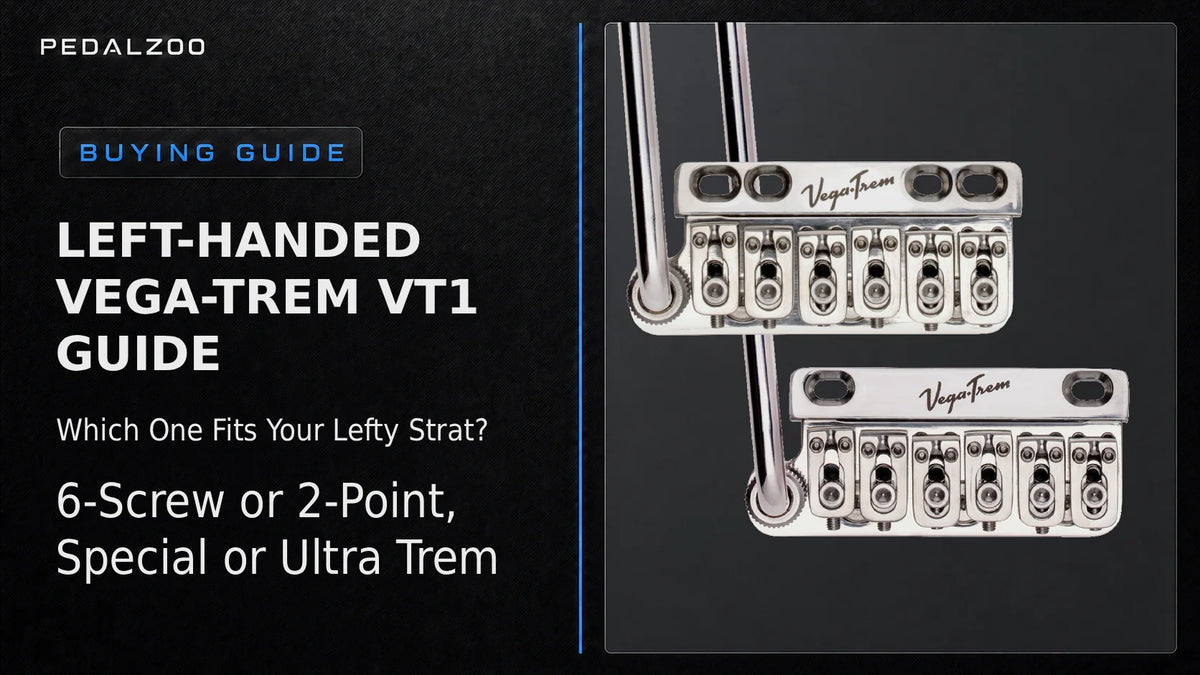
Quick answer: Vega-Trem builds real left-handed VT1 bridges — not a right-handed unit with the arm swapped. First figure out your bridge hardware: six small pivot screws along the front edge means VT1 Left-Handed 6-Screw, two larger posts means VT1 Left-Handed 2-Point. Then pick your line: VT1 Special (brass block, extra punch) or VT1 Ultra Trem (stainless-steel block, clearer and more neutral) — both lines ship left-handed, in the same finishes as right-handed, and both come with a left-handed tremolo arm already in the box. Confirm your exact guitar through the Pedalzoo Vega-Trem Compatibility Finder before ordering.
If you've read our VT1 Guide: 6-Screw vs 2-Point, Special vs Ultra, the mounting and tone logic here will look familiar — because it's the same logic. The only thing that changes for a left-handed Strat is which SKU carries that logic in mirrored form, and a couple of details that only apply once you flip the guitar around.
Why a Right-Handed VT1 Won't Work on a Lefty Strat
This is the question worth settling before anything else, because it's the one that causes actual returns. A Stratocaster's tremolo cavity is not symmetrical — the block, the spring claw route, and the arm exit are all cut to one side. On a left-handed body, that whole layout is mirrored. A right-handed VT1 dropped into a left-handed cavity does not simply feel awkward; the block orientation and arm side are wrong, and the bridge won't seat the way it's supposed to without cutting into wood that was never meant to be cut.
So "left-handed" here doesn't mean a cosmetic variant or a repositioned strap button. It means a bridge built with mirrored geometry from the block up, sized for a cavity that was routed in the opposite direction from a right-handed guitar. That's the whole reason this SKU exists as its own product line rather than a spare part.
Step One: 6-Screw or 2-Point — Same Rule as Always
The first decision is identical to the right-handed side of the lineup, and it still has nothing to do with your guitar's body shape, brand, or finish. Look at how your current bridge pivots. A traditional 6-Screw bridge pivots on six small screws running along its front edge. A 2-Point bridge pivots on two larger posts. Check the hardware itself, not the model name — plenty of otherwise-identical-looking lefty Strats ship with different bridge mounting depending on year and factory.
Get this step wrong and the mismatch shows up immediately: the post and route pattern won't line up, mirrored or not. This is still the single most common ordering mistake with any drop-in trem, lefty or right-handed.
Step Two: VT1 Special or VT1 Ultra Trem
Once the mounting type is settled, the tonal choice is exactly the same fork as the right-handed guide — and this matters, because it means left-handed players are no longer choosing from a shrunken lineup. Both lines are built left-handed, in both mounting types, and in the full run of finishes.
| VT1 Special (Left-Handed) | VT1 Ultra Trem (Left-Handed) | |
|---|---|---|
| Block material | Solid brass block | Stainless-steel block |
| Tonal character | Extra punch and response, favored by rock and high-gain players | Clearer, more neutral, more versatile across styles |
| Available mounting | 6-Screw or 2-Point | 6-Screw or 2-Point |
| Finishes | Glossy, Satin, Black, Gold | Glossy, Satin, Black, Gold |
| Tremolo arm | Left-handed arm included | Left-handed arm included |
Neither line is "the lefty version" of the other — both are full left-handed products in their own right. If you dig in with a high-gain amp and want the bridge to push back with some punch, VT1 Special 6-Screw Left-Handed or its 2-Point counterpart is the call. If you want the bridge to stay tonally neutral across clean and driven tones, VT1 Ultra Trem 6-Screw Left-Handed or the 2-Point Left-Handed version is the more predictable starting point.
Finishes: No Shrunken Lefty Palette
Left-handed VT1 buyers get the same four finishes as right-handed buyers — Glossy, Satin, Black, and Gold — across both VT1 Special and VT1 Ultra Trem. That's worth stating plainly because it hasn't always been true of trem systems generally: plenty of vibrato bridges treat left-handed buyers as an afterthought with one finish and a "check back later" note on everything else. Here, finish is a cosmetic choice, not a constraint you have to work around. See the current stock across Special Black, Special Gold, and Special Satin.
The Tremolo Arm: Already Handled
This comes up in almost every lefty gear forum thread, so it's worth answering directly: no, you do not need to source a separate left-handed tremolo arm. Every left-handed VT1 — Special or Ultra Trem, either mounting type — ships with its own left-handed arm already in the box, bent for the correct side and correct reach. You're not getting a right-handed arm that happens to thread in fine but points the wrong way; the arm in the package is built for the guitar you're installing it on.
That's a genuinely different situation from a lot of used or vintage-market lefty tremolo swaps, where a right-handed arm will screw into a left-handed block just fine — the threads usually match — but the bend runs the wrong direction and feels backwards under your palm. With the VT1, that mismatch simply doesn't happen, because the correct arm is part of the standard package rather than a separate purchase.
A Quick Aside: Reverse Trems on Right-Handed Guitars
Every so often this question comes from the other direction: a right-handed player wants a left-handed-style bridge orientation on a right-handed guitar — the classic Stevie Ray Vaughan look, with the arm sitting above the strings instead of below. That's a real and well-documented setup choice, but it's a different job than what this guide covers. Because the tremolo cavity is asymmetrical, mounting a left-handed VT1 on a right-handed body means the route doesn't match, and you're back to the routing question the whole VT1 platform exists to avoid. If that's the look you're after, treat it as a separate project with its own routing and setup considerations — not a simple parts swap.
What's in the Box
Left-handed VT1 packaging mirrors the right-handed kit component for component — nothing is stripped down or simplified for the left-handed version:
- Block with saddles and fulcrum, plus a left-handed tremolo arm
- Accessory bag matched to your mounting type — four fulcrum screws for 6-Screw, or fulcrum adapters and two screws for 2-Point — with the correct Allen keys
- Four spring bags by tension: Extra Low, Low, Medium, and High, so you can match spring resistance to your string gauge and preferred arm feel
Everything here is about mirrored geometry, not a different assembly process — the same saddles, the same pivot system, and the same manufacturing quality that the right-handed VT1 lineup uses.
Before You Order: The Same Fit Check, Mirrored
Confirm three things before adding a left-handed VT1 to your cart:
- Your guitar is genuinely left-handed — not a right-handed body with a reverse headstock, which is a different thing and doesn't automatically mean a left-handed tremolo cavity
- Your current bridge is 6-Screw or 2-Point — check the pivot hardware itself, the same rule as always
- Your Strat-style guitar already has a factory tremolo cavity based on the original ST-type routing — VT1 is a drop-in replacement, not a router job
If you're building a partscaster or working from a non-Fender left-handed body, double-check that the cavity was actually cut as a left-handed route before you buy — a left-handed neck or headstock on its own doesn't guarantee a mirrored bridge cavity underneath. When in doubt, run the exact guitar through the Pedalzoo Vega-Trem Compatibility Finder before checkout.
The 60-Second Decision
Start with handedness: confirm your Strat is genuinely left-handed, cavity and all. Then check your bridge hardware — six screws along the front edge means 6-Screw, two larger posts means 2-Point. Then pick your tone: brass block and extra punch means VT1 Special, stainless-steel block and a more neutral voice means VT1 Ultra Trem. The tremolo arm is already sorted either way. Whatever you land on, confirm it through the Compatibility Finder before you check out.
Browse every left-handed and right-handed VT1 variant, mounting type, and finish at Vega-Trem on Pedalzoo.
FAQ
Can I install a right-handed VT1 on a left-handed Strat?
No. The tremolo cavity is asymmetrical, and a right-handed bridge won't seat correctly in a left-handed route without cutting into the body.
Do I need to buy a separate left-handed tremolo arm?
No. Every left-handed VT1 — Special or Ultra Trem, either mounting type — ships with its own correctly bent left-handed arm included.
How do I know if my lefty Strat is 6-Screw or 2-Point?
Look at the bridge hardware itself: six small screws along the front edge means 6-Screw, two larger posts means 2-Point. Body shape, brand, and finish don't tell you this.
Is VT1 Special left-handed different from VT1 Ultra Trem left-handed?
Only in block material and resulting tone — brass for Special, stainless steel for Ultra Trem. Saddles, pivot system, and build quality are the same across both.
Does a reverse-headstock right-handed guitar need a left-handed VT1?
Not necessarily. A reverse headstock alone doesn't mean the body has a left-handed tremolo cavity — check the actual bridge route, not just the neck.
Can I get a Stevie Ray Vaughan–style reverse trem on my right-handed Strat?
That's a different project involving actual body routing, not a parts swap — a left-handed VT1 won't drop into a right-handed cavity.
Is there a left-handed VT2ND for Telecaster?
Not currently — VT2ND is right-handed only. This guide covers the VT1 Strat platform.
Do left-handed VT1 bridges come in every finish?
Glossy, Satin, Black, and Gold are available across the left-handed VT1 Special and Ultra Trem lines.