
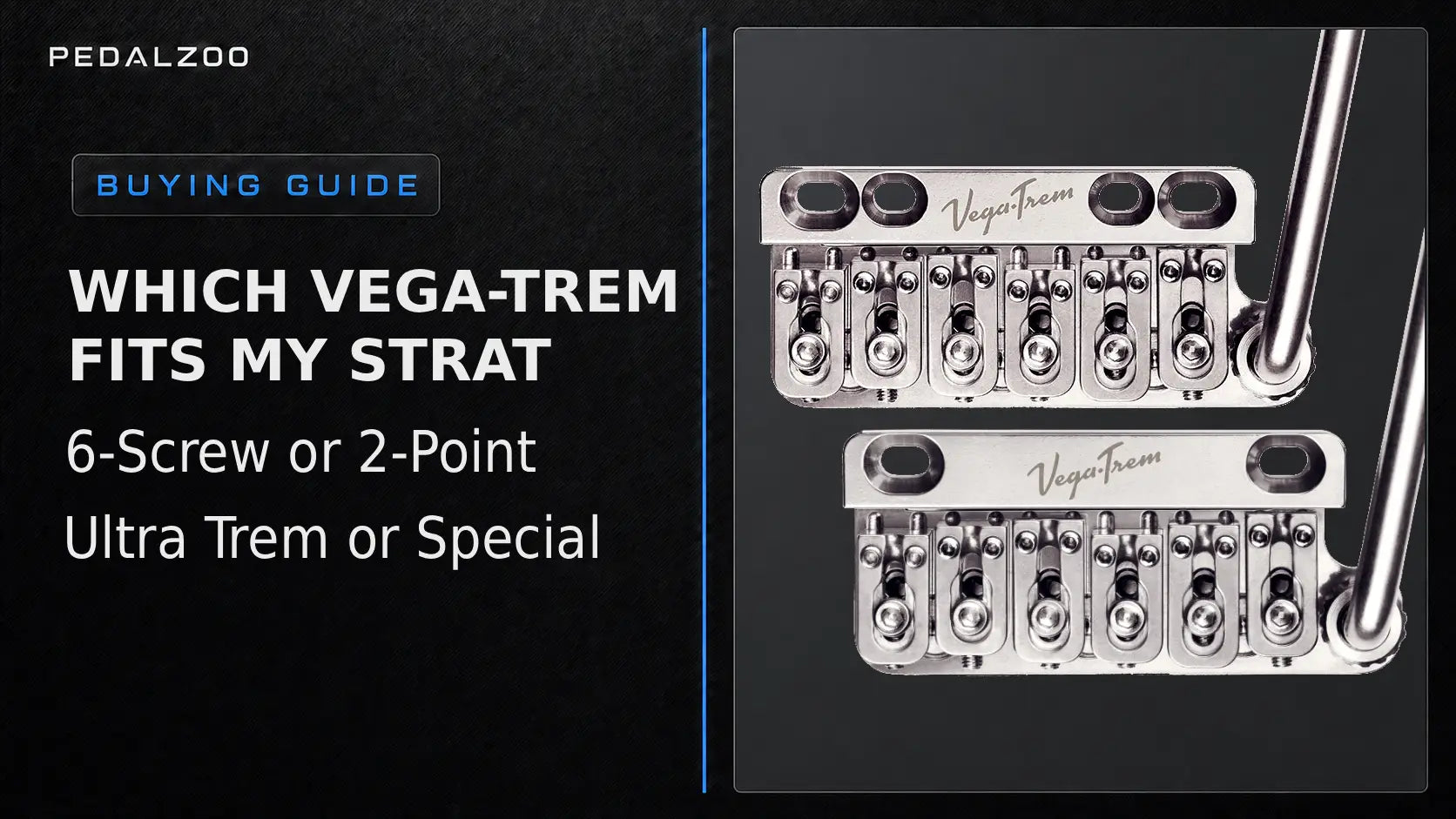
Quick answer: Got a Strat with a 6-Screw bridge? Start with the VT1 Special 6-Screw. Got a 2-Point Strat bridge? Get the VT1 Special 2-Point. Want a more neutral, versatile tone instead of extra brass punch? Step up to VT1 Ultra Trem in the matching mount. Before you order anything, run your exact guitar through the Pedalzoo Vega-Trem Compatibility Finder — this is a "measure twice" purchase, not a "looks about right" one.
Vega-Trem's VT1 solves a problem Strat players have complained about for decades: getting real up-and-down vibrato without routing the body or living with a Floyd Rose setup that eats an afternoon every time you change strings. The catch is that the lineup has more variants than most buyers expect, and picking the wrong one means a return, not a quick fix.
Why This Bridge Exists
Vega-Trem was built around one specific constraint: do not touch the guitar body. Founder Isaac Vega designed the VT1 specifically so decades-old Strat bodies never need a router, working within the original bridge cavity that Leo Fender's design already provides. The company describes this directly as a respect-driven design choice — many of the guitars this bridge goes into "might have been on planet Earth for up to 70 years," and the goal is to add real two-way vibrato without degrading a vintage body's value.
That constraint is also why the lineup is organized the way it is. Instead of one universal bridge, Vega-Trem builds separate versions for each of the two bridge-mounting hardware types Stratocasters use — and getting that first choice right matters more than any tonal decision that follows.
Step One: 6-Screw or 2-Point Comes Before Anything Else
Before you think about which VT1 line to buy, you need to answer one question that has nothing to do with your guitar's body shape, finish, or model name: how does your current bridge pivot? A traditional 6-Screw bridge pivots on six screws running along its front edge. A 2-Point bridge pivots on two larger posts. Both mounting systems show up across Strat-style guitars regardless of brand or price point, so check the bridge hardware itself, not the guitar model.
Get this wrong and the bridge will not drop into your existing cavity — the post and route pattern simply won't line up. This is the single most common mistake buyers make with any drop-in trem system, and it's exactly why Pedalzoo's product listings for every VT1 variant open with the same warning: confirm your exact guitar model and mounting type before ordering, not after.
VT1 Special vs. VT1 Ultra Trem: Same Bones, Different Block
Once you know your mounting type, the real decision is between the two VT1 lines. They share identical saddles, the same pivot system, and the same manufacturing quality — this isn't a "budget vs. premium" split in build quality, it's a material and tone choice.
| VT1 Special | VT1 Ultra Trem | |
|---|---|---|
| Block material | Solid brass block | Stainless-steel block |
| Tonal character | Extra punch and response, favored by rock and high-gain players | Clearer, more neutral, more versatile across styles |
| Price positioning | The more accessible VT1 line | The premium tonal upgrade |
| Available mounting | 6-Screw or 2-Point | 6-Screw or 2-Point |
If you dig in hard with a high-gain amp and want a bridge that pushes back with punch, VT1 Special's brass block is the right call. If you want a bridge that gets out of the way tonally and behaves consistently whether you're playing clean or driven, VT1 Ultra Trem's stainless-steel construction is the more neutral starting point. Neither line is "better" in an absolute sense — this is a voicing decision, similar to choosing a pickup.
What Owners Actually Say After Living With It
The consensus across long-term owner threads is unusually consistent: the vibrato action itself is the standout feature, more than the tone change. One four-month update on a well-known gear forum reported tuning stability "at least as good as its competition and slightly better" compared to a Gotoh 510 with a zinc block, smooth trem action "like the old Kahlers," and enough upward pull range to match "a Floyd with a body rout" — all without routing anything. The same owner also flagged real friction points: stringing it up is fiddly because of small string holes in the block, dialing it parallel to the body takes patience with the spring claw screws, and intonation setup is more involved than a standard bridge.
A Strat-Talk owner who's had one installed in a partscaster for years described the tonal shift as unlocking "harmonics that shimmer to an expanded dimension," while a written review on That Guitar Lover called it "the best vibrato bridge I've ever played on a Stratocaster" and specifically praised the total lack of catch or lag in the vibrato action compared to a stock Fender trem. That same reviewer clocked the full install and setup at about two hours for a first attempt, and noted a genuine quirk worth knowing in advance: because there's no bridge plate covering the string holes the way a traditional Fender bridge has one, if your guitar has a spring cover with holes for restringing, those holes won't line up with the Vega-Trem's string holes — you'll likely restring with the cover off.
Not every account is glowing. One recurring complaint across owner threads is price: multiple owners flag the VT1 as "too expensive" relative to alternatives, even while praising the build quality and feel. First-impression threads on Strat-Talk also mention early tuning quirks on hard upward pulls until strings are properly stretched in and lubrication is applied to the nut — a normal break-in step for any trem, but one new owners aren't always expecting.
The Compatibility Question Nobody Skips For Free
Vega-Trem's own FAQ lists guitars broadly compatible with the VT1 platform — Fender Stratocaster and Squier Stratocaster, PRS, Music Man (Silhouette, Luke, Axis), Suhr, Tom Anderson, Schecter, Charvel EVH, Ernie Ball Music Man, Ibanez EHV, Warmoth, and several others — but explicitly frames that list as an estimate, not a guarantee. The real rule is broader and simpler: VT1 fits any guitar built around the original routing pattern for ST-type tremolo cavities, regardless of brand.
That's precisely why Pedalzoo built a dedicated Vega-Trem Compatibility Finder rather than relying on a static list. Bridge mounting hardware varies even within the same guitar model across production years, and getting it wrong means a return shipment, not a five-minute fix. If your exact model isn't listed anywhere, or you're not fully sure whether your bridge is 6-Screw or 2-Point, that's the tool to check before adding anything to your cart.
Setup Realities: Locking Tuners, Locking Nuts, and Other Myths
A few misconceptions come up constantly in buyer questions, and Vega-Trem's own FAQ addresses them directly. You do not need a locking nut to run a VT1 — in fact, the opposite is emphasized: the smoother strings move through the nut, the better tuning stability gets, which argues for good nut lubrication over locking hardware. Locking tuners aren't required either; the system works equally well with vintage-style tuners as long as they're in good condition and meet basic quality standards.
What actually affects tuning stability, according to both the manufacturer and long-term owners, is more mundane: tuner quality, nut condition and lubrication, spring balance, and a proper initial setup. The VT1's double-action design does allow more total movement than a standard vintage-style trem, and more range naturally means more can go into flux if the rest of the setup isn't dialed in — that's a mechanical trade-off, not a defect.
Comparison Table: Which VT1 Fits Your Strat
| Model | Mounting type | Block material | Tonal character | Price (CAD) |
|---|---|---|---|---|
| VT1 Special 6-Screw | 6-Screw | Solid brass block | Extra punch, rock and high-gain focused | From 279.95 |
| VT1 Special 2-Point | 2-Point | Solid brass block | Extra punch, rock and high-gain focused | From 279.95 |
| VT1 Ultra Trem 6-Screw | 6-Screw | Stainless-steel block | Clearer, more neutral, versatile | From 379.95 |
| VT1 Ultra Trem 2-Point | 2-Point | Stainless-steel block | Clearer, more neutral, versatile | From 379.95 |
All models are also available in left-handed configurations and multiple finishes (Glossy, Satin, Black, Gold). Browse every variant, finish, and handedness at Vega-Trem on Pedalzoo.
The 60-Second Decision
Start with your bridge hardware. Check whether your current bridge pivots on six screws along the front edge (6-Screw) or two larger posts (2-Point) — look at the hardware itself, not your guitar model or year.
Then pick your tone. Want extra punch for rock and high-gain playing → VT1 Special's brass block. Want a clearer, more neutral tone that behaves the same across styles → VT1 Ultra Trem's stainless-steel block.
And whatever you land on, run it through the Pedalzoo Vega-Trem Compatibility Finder before checkout. Every long, painful return story in the owner forums traces back to the same root cause: someone matched the bridge to the guitar's look instead of its actual mounting hardware.