
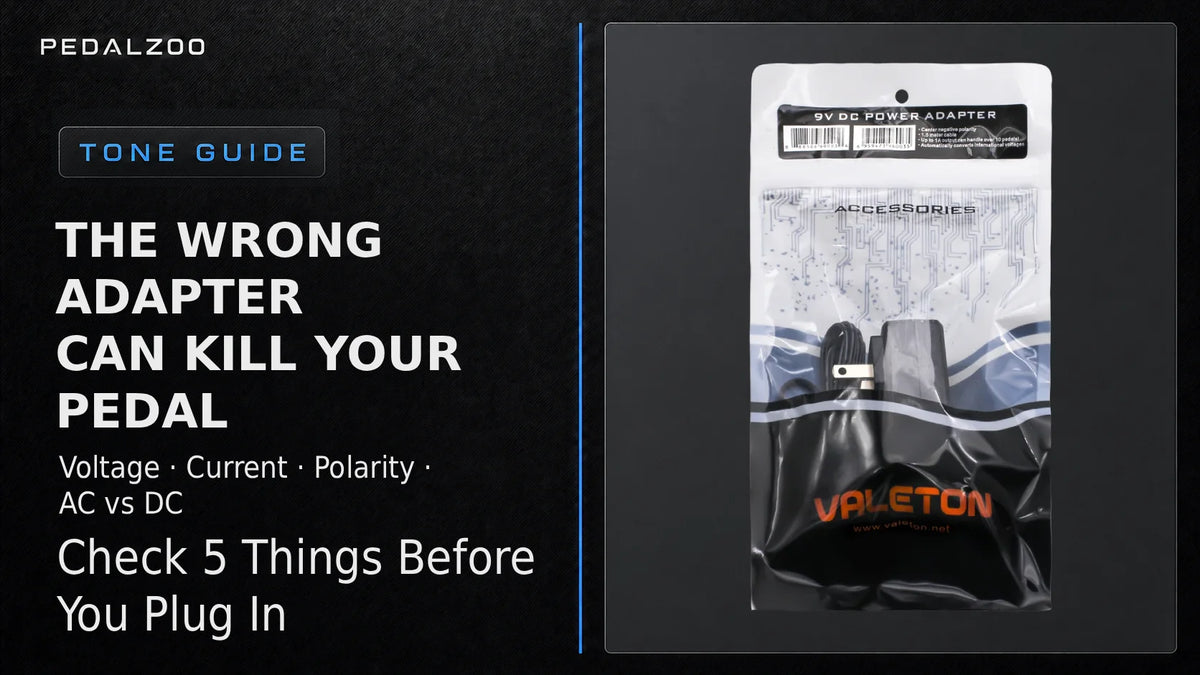
Getting the wrong power supply doesn't just leave a pedal silent — it can destroy it in seconds. Before you plug anything in, check five things: voltage, current, polarity, current type (AC or DC), and connector size.
Quick Answer: Check These Five Things Before You Plug In
| Check | What must match? | Safe rule |
|---|---|---|
| Voltage | Pedal specification | Use the exact voltage, or a range explicitly approved by the manufacturer |
| Current | Supply capacity vs. pedal draw | The output must provide at least as many mA as the pedal needs — more is fine |
| Polarity | Center-negative or center-positive | Must match exactly |
| Current type | DC or AC | Never substitute one for the other |
| Connector | Plug diameter and wiring | Confirm the barrel size and polarity, not just "does it fit" |
Never assume a plug is compatible just because it fits. A 2.5mm plug will slide into a 2.1mm jack and make poor contact; the wrong polarity can look identical to the right one on the shelf.
The one rule worth memorizing: voltage and polarity must match exactly, but available current can be higher than the pedal's draw. A pedal only pulls the current it needs — a 500mA output won't overpower a 20mA pedal.
Start With the Pedal, Not the Power Supply
Before shopping for an adapter, find the pedal's actual power label. It usually reads something like 9V DC, center-negative, minimum 300mA.
Break the label into parts
- 9V — the required voltage
- DC — direct current, not AC
- Center-negative — the polarity of the barrel plug
- 300mA minimum — the lowest current the supply must provide
Where to check
- The product page's Specifications section
- Printed next to the power jack on the pedal itself
- The manufacturer's manual
- The label on the included adapter
Voltage: The Number You Must Not Guess
Most pedals run on 9V, but 12V, 18V, and 24V pedals are common too. A pedal marked "9V only" cannot safely take 12V or 18V. A pedal marked "9–18V" is designed to accept the entire range — but that doesn't mean every 9V pedal can be pushed to 18V.
Fixed voltage
The Valeton Dapper Mini requires a 9V DC center-negative adapter rated for at least 110mA. Feeding it anything else risks damage.
Variable voltage
The Friedman BE-OD is officially rated for 9–18V DC. Origin Effects' Cali76 Stacked Edition is built the same way, accepting 9–18V for extra headroom.
The safe rule isn't "never exceed what's printed" — it's never exceed the highest voltage explicitly approved for that exact pedal.
Current: Why a Higher mA Rating Is Usually Safe
A power supply's mA rating is its maximum capacity, not what it forces into the pedal. A pedal only draws the current its circuit actually needs.
| Pedal | Voltage | Current draw |
|---|---|---|
| Wampler Tumnus Overdrive | 9V | 20mA |
| Valeton Dapper Mini | 9V | 110mA minimum |
| Eventide Rose | 9V | 500mA |
| T-Rex TwinBlaze | 12V | ~500mA |
| T-Rex SoulMate Acoustic | 12V | 560mA |
Notice T-Rex SoulMate needs 12V, not 9V — plugging in a standard 9V supply won't power it correctly even if the current is sufficient.
As a rule of thumb, don't run an output at more than 50–75% of its rated capacity for long-term reliability — leave headroom rather than loading it right to the limit. Digital pedals can also draw a brief current spike on power-up, higher than their steady-state rating.
Polarity: Reading the Center-Negative Symbol
Most guitar pedals use center-negative polarity: the center pin carries negative, the outer sleeve carries positive. The symbol on a power supply shows a dot (center) and a ring (sleeve), with plus and minus signs indicating which is which.
Don't identify polarity by the shape of the plug or cable angle — read the symbol. A cable can physically fit and still deliver the wrong polarity, which can damage a pedal instantly.
When "center-negative" isn't the rule: Eventide H9
The Eventide H9 requires 9–12V DC, center-positive, on a 5.5/2.5mm jack — the exact opposite of the usual assumption. Standard 9V center-negative adapters (usually 2.1mm, not 2.5mm) are not compatible without an adapter cable. Going above 12V — even 15V — can cause real damage and isn't covered under warranty.
DC vs. AC: Similar Labels, Different Power
Most pedals run on DC. Some require AC, and the two are not interchangeable even when the voltage number matches.
Line 6 DL4: the classic AC exception
The original Line 6 DL4 needs 9V AC at 2000mA, not DC. Plugging in a standard 9V DC adapter — even a high-current one — won't power it correctly. Later Line 6 four-button stompboxes moved to 12V DC center-positive instead, which trips up owners who assume every Line 6 pedal shares one spec.
Debunking the "18V Sounds Better" Myth
Some overdrive and boost pedals do sound different at 18V versus 9V — usually more headroom before clipping. But higher voltage is not automatically better, and it's not universally safe.
- A pedal must be explicitly rated for 9–18V. Running an unrated 9V-only pedal at 18V is highly likely to destroy it.
- Even on approved pedals, more voltage changes the character of the sound — it doesn't uniformly improve it.
- Confirm the specific circuit, not just the brand. Not every pedal from a 9–18V-friendly manufacturer shares that rating.
One EHX Adapter That Confuses Everyone
Electro-Harmonix labels many of its power supplies 9.6V DC, 200mA — a number that alarms buyers who assume their existing 9V supply won't work.
It isn't special. 9.6V is simply what a fresh 9V battery actually outputs when new. EHX pedals are designed around that real-world figure, and a standard, well-regulated 9V DC center-negative supply works fine in practice — as long as you verify the exact model before deviating from the box's instructions.
Connector Size: "It Fits" Isn't a Specification
The most common barrel connector is 5.5mm outer diameter by 2.1mm inner diameter. A less common but still frequent size is 2.5mm inner diameter, used by some Eventide, Line 6, and Elektron gear.
A 2.5mm plug will physically slide into a 2.1mm jack, but the center pin won't make firm contact — fit alone tells you nothing about whether the connection is electrically sound. Always confirm both diameter and polarity together.
Choosing How to Power Your Whole Board
Battery or dedicated adapter
Works only if the pedal has a battery compartment — many modern high-current pedals, like the Wampler Tumnus, run on DC power only. A dedicated adapter is the simplest option for a single pedal.
Daisy chain
Can work for a handful of low-current analog pedals with matching voltage and polarity. Every pedal on the chain shares the same ground path, so noise from one can bleed into the others.
Isolated power supplies give each output its own separate circuit with no shared ground, preventing noise transfer entirely. This is the safer default for mixed digital/analog boards or any board that's already producing hum.
Current doubler: useful. Voltage doubler: warning only.
A current doubler can be a valid solution when one pedal needs more current than a single isolated output provides. A voltage doubler is different — it raises the voltage delivered, so treat it as an advanced-risk tool, not a casual workaround, and never use one unless the pedal explicitly supports the resulting voltage.
The trap: a power supply can have ten physical jacks and still not give you ten isolated circuits. Some outputs share an internal section and are not electrically separate from each other. Check how a supply's outputs are actually grouped, not just how many sockets it has.
Real Pedals, Real Power Choices
| Pedal | Requirement | Common mistake |
|---|---|---|
| Wampler Tumnus | 9V DC, 20mA, no battery | Assuming a 500mA output is "too powerful" for it |
| Valeton Dapper Mini | 9V DC center-negative, 110mA min. | Using an old, low-current 9V output |
| Eventide Rose | 9V DC, 500mA | Underpowering it from a 100mA-per-output supply |
| Friedman BE-OD | 9–18V DC | Assuming 18V is safe for every other 9V pedal on the board |
| T-Rex SoulMate Acoustic | 12V DC, 560mA | Trying a spare 9V adapter instead |
| Eventide H9 | 9–12V DC, center-positive, 5.5/2.5mm | Using a standard center-negative 2.1mm cable |
Troubleshooting a Pedal That Won't Power On
- No power at all — recheck voltage, polarity, and connector size against the exact model's spec.
- Powers on but reboots or glitches — the output likely can't sustain the pedal's current draw, especially during startup surge.
- Hum or buzz — usually a shared ground path; try isolating the pedal on its own output.
- Digital ticking or whine — a digital pedal is likely sharing a daisy chain with sensitive analog gear.
- Works alone, noisy on the full board — the issue is almost always shared power or ground interaction.
30-Second Checklist Before You Connect
- Exact pedal model and its printed power spec confirmed
- Voltage matches, or falls within an explicitly approved range
- DC or AC confirmed — not just voltage
- Polarity confirmed by symbol, not by cable shape
- Output current meets or exceeds the pedal's draw
- Connector diameter confirmed, not just "it fits"
- Daisy chain total current calculated, if applicable
- Digital and analog pedals separated where noise is a concern
FAQ
Can I use a 500mA power supply with a 100mA pedal?
Yes, as long as voltage, polarity, current type, and connector all match. The pedal only draws the current it needs.
Can I power a 9V pedal with 12V or 18V?
Only if the manufacturer explicitly lists that voltage as supported for that specific model.
Are all guitar pedals center-negative?
No. It's the most common standard, but exceptions exist — the Eventide H9 is center-positive.
Can a power plug fit but still be wrong?
Yes. A 2.5mm plug can slide into a 2.1mm jack without making reliable contact, and polarity can be reversed even when the size matches.
Can I use an AC adapter on a pedal that needs DC?
No, unless the manufacturer specifically says otherwise. The Line 6 DL4 is a rare pedal that needs AC, not DC.
Is EHX's 9.6V rating a special requirement?
No — it reflects a fresh 9V battery's real voltage. A standard, well-regulated 9V DC supply works for most EHX pedals.
Can I mix digital and analog pedals on a daisy chain?
It can work, but this combination is the most common source of hum and ticking noise on a shared chain.
Does higher voltage always sound better on 9–18V pedals?
No. It changes headroom and clipping character — that's a preference, not a universal upgrade, and it only applies to pedals explicitly rated for the range.