
The 20-second answer
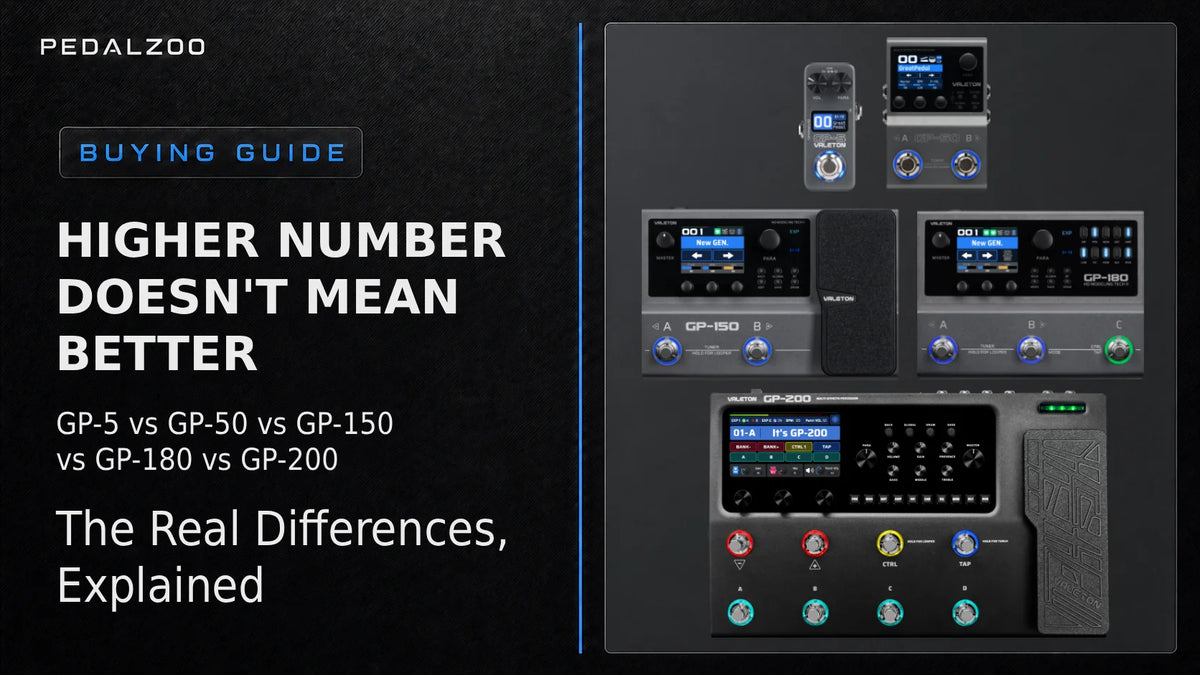
Every Valeton GP unit shares the same design philosophy — flagship-style modeling in an affordable, gig-ready box — but the five current models are not one straight upgrade ladder. They split into three distinct platforms, and the right pick depends on how you actually play, not on which model number is highest.
- Valeton GP-5 — the smallest backup rig or NAM/IR loader you can fit in a pocket.
- Valeton GP-50 — the same idea with two footswitches, an internal battery, and an onboard looper.
- Valeton GP-150 — Valeton's newer 48 kHz platform with a built-in expression pedal, for a self-contained fly rig.
- Valeton GP-180 — the same new platform, but traded the expression pedal for a third footswitch and ten direct-access module buttons.
- Valeton GP-200 — the full stage floorboard, with eight footswitches, XLR outputs, an FX loop, and 5-pin MIDI.
| If you need… | Best fit | Why |
|---|---|---|
| Smallest possible backup rig | GP-5 | 237 g, one footswitch, fits in a gig-bag pocket |
| Self-contained practice rig | GP-50 | Battery, two footswitches, built-in looper |
| Portable rig with onboard expression | GP-150 | Built-in pedal, 48 kHz engine, 12 blocks |
| Compact hands-on command centre | GP-180 | Three switches, module buttons, two EXP/FS ports |
| Full stage floorboard | GP-200 | 8 switches, XLR, FX loop, 5-pin MIDI |
Start here: what kind of rig do you actually need?
Before comparing specs, answer one question: what job does this unit have to do?
A pedalboard add-on or emergency backup. You already have pedals, or you just want a compact unit tucked in your gig bag in case your main rig fails. The GP-5 is built exactly for this — a single footswitch, dual power options, and a metal chassis the size of a stompbox.
A self-contained practice or bedroom rig. You want to plug in, hit a footswitch, and not touch your phone every time. The GP-50 adds a second footswitch, onboard looper, drum machine, and a 1450 mAh battery so it works fully unplugged.
A battery-powered rig you can gig with standalone. You want expression control, a real display, and enough processing for a whole set without external pedals. This is the GP-150 or GP-180 territory — pick between them based on the next section.
A complete stage command centre. You need XLR outs to run direct to a PA, an FX loop to keep your favorite analog pedals in the chain, and enough footswitches to control a whole set without menu diving. That's the GP-200.
The GP range is three platforms, not one ladder
It's tempting to assume higher numbers always mean “better,” but Valeton's lineup actually splits into three separate hardware generations.
Compact platform — GP-5 and GP-50. Both run 24-bit/44.1 kHz audio, handle up to 9 simultaneous effect blocks, store 100 patch slots, and load up to 80 SnapTone files plus 20 third-party IRs. The GP-5 keeps this in the smallest possible footprint; the GP-50 adds real-world controls and a battery.
New portable platform — GP-150 and GP-180. Both run Valeton's second-generation HD modeling engine at 48 kHz, support up to 12 freely-ordered effect blocks, hold 200 patch slots, store up to 100 SnapTone files, and include a 3000 mAh battery good for 6+ hours.
Stage platform — GP-200. Runs 24-bit/44.1 kHz audio with up to 11 simultaneous modules, 256 patch slots, eight footswitches, a built-in expression pedal, balanced XLR outputs, an FX loop, and standard 5-pin MIDI — but no internal battery or Bluetooth.
GP-5 vs GP-50: is the upgrade worth it?
This is the first real fork in the road, and it comes down to whether you want a minimal pedal or a small standalone rig.
| GP-5 | GP-50 | |
|---|---|---|
| Footswitches | 1 | 2 |
| Onboard looper | No | Yes |
| Battery | None | 1450 mAh internal |
| Drum machine | App only | Built-in + app |
| Simultaneous modules | 9 | 9 |
| SnapTone (NAM) capacity | 80 (50 preloaded) | 80 (50 preloaded) |
| Weight | 237 g | 430 g |
Choose the GP-5 if size is the deciding factor and you're fine editing through the phone app most of the time.
Choose the GP-50 if you want the unit to work as a self-contained rig — preset switching, looping, and drum practice without pulling out your phone every time.
Skip the GP-5 if you plan to gig live and need fast, hands-on preset switching — one footswitch limits you quickly.
Skip the GP-50 if the extra footswitch and battery genuinely don't matter to your setup — then you're paying for convenience, not new sound.
GP-150 vs GP-180: expression pedal or command centre?
Both units run the exact same second-generation engine, battery, and I/O core. The real decision is entirely about hardware control layout.
| GP-150 | GP-180 | |
|---|---|---|
| Footswitches | 2 + built-in expression pedal | 3, no built-in expression |
| Module shortcut buttons | 6 quick-access buttons | 10 dedicated module buttons |
| EXP/FS ports | 1 | 2 |
| Bypass modes | DSP bypass only | Analog + DSP bypass |
| MIDI footswitch commands | No | Yes |
| Weight | 958 g | 843 g |
| Dimensions | 200 × 139 × 55 mm | 181 × 139 × 52 mm |
Choose the GP-150 if you want a true one-piece fly rig with a built-in expression pedal for wah or volume, and two footswitches cover your needs.
Choose the GP-180 if you want a third footswitch, instant per-module access buttons, analog bypass, and two expansion ports for a larger MIDI-controlled setup.
Neither is a “downgraded” version of the other — they're the same engine in two different control philosophies.
GP-180 vs GP-200: newer engine or fuller stage hardware?
This is the comparison that trips people up, because it's easy to assume the newer model automatically replaces the older flagship. It doesn't.
GP-180 advantages: smaller and lighter, internal battery, Bluetooth 5.0, 48 kHz sampling, ten direct module-access buttons, ideal for a compact hybrid pedalboard.
GP-200 advantages: eight footswitches instead of three, a built-in expression pedal, an FX loop for blending in analog pedals, balanced XLR outputs for running straight into a PA, standard 5-pin MIDI, and a larger 4.3-inch screen.
The GP-180 is the newer, more compact command centre. The GP-200 is still the fuller stage floorboard. Neither one is a strict replacement for the other — pick based on whether XLR/FX loop/expression-pedal hardware matters more to you than battery power and size.
Does the newer 48 kHz engine actually sound better?
Yes — and this is one place worth being direct rather than vague. The GP-150 and GP-180 run Valeton's second-generation HD modeling engine at a genuinely higher 48 kHz sample rate with a redesigned cabinet-simulation algorithm, compared with the 44.1 kHz engine still used in the GP-5, GP-50, and GP-200. Reviewers testing the new platform against the older GP-5/GP-50/GP-200 line consistently describe it as a noticeable step up in clarity and realism, closer to the feel of real hardware and with less of the “digital” edge associated with the earlier chip. Multiple outlets covering the launch independently confirmed the same 48 kHz jump and cabinet-modeling redesign as the core technical upgrade.
That said, the newer engine is not an automatic win in every single side-by-side. One controlled blind test comparing the GP-180 against the GP-200 using the same external IR found the two units surprisingly close once the same cabinet response was applied to both — meaning the sample-rate advantage matters most when you're relying on Valeton's own onboard cabs rather than your own IRs. So the honest framing is: the 48 kHz platform is a real, confirmed upgrade, and it is the reason the GP-150/GP-180 are the best-reviewed Valeton engine to date — but it's not a magic fix if you're already loading your own high-quality IRs into an older unit.
Connections that matter more than effect counts
Effect counts look impressive on a spec sheet, but the connections decide whether a unit fits your actual rig.
- FX loop — only the GP-200 has one, letting you keep favorite analog pedals in the signal chain.
- XLR outputs — only the GP-200 offers balanced XLR for a direct PA connection.
- MIDI type — GP-5/GP-50 use TRS or USB MIDI; GP-150/GP-180 add Bluetooth MIDI; GP-200 uses standard 5-pin MIDI connectors.
- Headphone jack — GP-150/GP-180 use a 3.5 mm TRRS jack that doubles as a streaming headset mic input.
- USB audio interface — GP-5/GP-50 offer 2-in/2-out; GP-150/GP-180/GP-200 step up to 6-in/4-out.
If your rig depends on an FX loop or XLR outs, that alone rules out four of the five models regardless of sound quality.
What can go wrong: real limitations before you buy
No unit here is flawless, and it's worth knowing the trade-offs before you order.
GP-5. One footswitch limits live control, and there's no onboard looper — you're leaning on the app for a lot of editing. Some owners have reported freezing that a factory reset resolved, and a February 2026 Windows 11 security patch briefly broke firmware-update detection for some users before Microsoft addressed it.
GP-50. Still on the older 44.1 kHz platform with 9 modules and 100 patches. A handful of owners have reported issues like occasional lockups, accidental bank changes, and OTG recording noise — worth checking current firmware notes before buying.
GP-150 / GP-180. No FX loop and no XLR outputs. You can't run two instances of the same effect type in one chain, and a demanding module combination (NAM + IR + several other blocks) can occasionally hit a processing ceiling. Users also note a small gap in sound when switching presets, and the GP-150's built-in expression pedal doesn't feel quite as smooth as a dedicated external pedal.
GP-200. No internal battery and no Bluetooth, so it needs a standard 9V supply on every gig. It's also larger and heavier than the newer units, and its presets are not directly compatible with the GP-180 due to a different firmware architecture.
What about the GP-200JR and other GP-200 variants?
Beyond the five core models, Valeton also sells a few GP-200 variants worth knowing about if you need that platform's I/O in a different shape. The GP-200JR runs the same engine and effects library as the GP-200 but in a smaller, three-footswitch chassis with a built-in expression pedal, XLR outputs, and an FX loop — a good option if you want GP-200 connectivity without the full-size footprint. The GP-200R and GP-200X are essentially the same hardware in different finishes, and the GP-200LT trims the expression pedal for an even lighter build. None of these change the core decision in this guide — they're simply alternate shapes of the same stage platform.
FAQ
Is the GP-180 better than the GP-200?
Not strictly — it's newer and more compact, but the GP-200 still has more footswitches, an FX loop, and XLR outputs the GP-180 lacks.
Does the GP-150 sound the same as the GP-180?
Yes. They share the same 48 kHz engine, effects library, and battery — the difference is entirely in footswitch layout and control hardware.
Is the GP-50 worth buying over the GP-5?
If a second footswitch, battery, and onboard looper matter to your workflow, yes. If size is your only concern, the GP-5 does the job smaller.
Can Valeton GP processors load NAM files?
Yes, through Valeton's SnapTone system, and this recently expanded. As of August 2026, Valeton rolled out NAM A2 support across the GP series: the GP-150 and GP-180 can load NAM A2 Lite files natively without conversion, while the GP-5, GP-50, GP-150, and GP-180 can all convert and load standard NAM A2 captures through the updated Valeton Suite software. The GP-200 and other GP-100/GP-200-family units received a separate compatible-software update (V1.8.1) that converts A2 files down to the existing SnapTone format rather than running them natively.
Can I use a Valeton GP directly into a PA?
Only the GP-200 has balanced XLR outputs for a clean direct connection; the others use 1/4" TS/TRS outputs.
Which models have an FX loop?
Only the GP-200 among the five core models.
Which models run on battery?
The GP-50 (1450 mAh), GP-150 and GP-180 (3000 mAh each). The GP-5 and GP-200 have no internal battery.
Which Valeton GP works best without a phone?
The GP-150 and GP-180 offer the most complete standalone editing via PC/Mac software and onboard controls, reducing reliance on the mobile app compared with the GP-5.