


About This Item
Description
The Jackson Audio New Wave turns a single stompbox into seven distinct stereo modulation voices, from lush 80s chorus to swirling rotary-speaker motion, using genuine analog bucket-brigade chips instead of a digital chorus algorithm.
Designed with Snarky Puppy guitarist Mark Lettieri, the New Wave keeps the audio path 100% analog while a microprocessor handles presets, LFO shapes, tap tempo and MIDI.
Why guitarists choose the New Wave
- Genuine MN3007 bucket-brigade chips, run at 15V internally, deliver true analog chorus and vibrato tone, not a digital emulation.
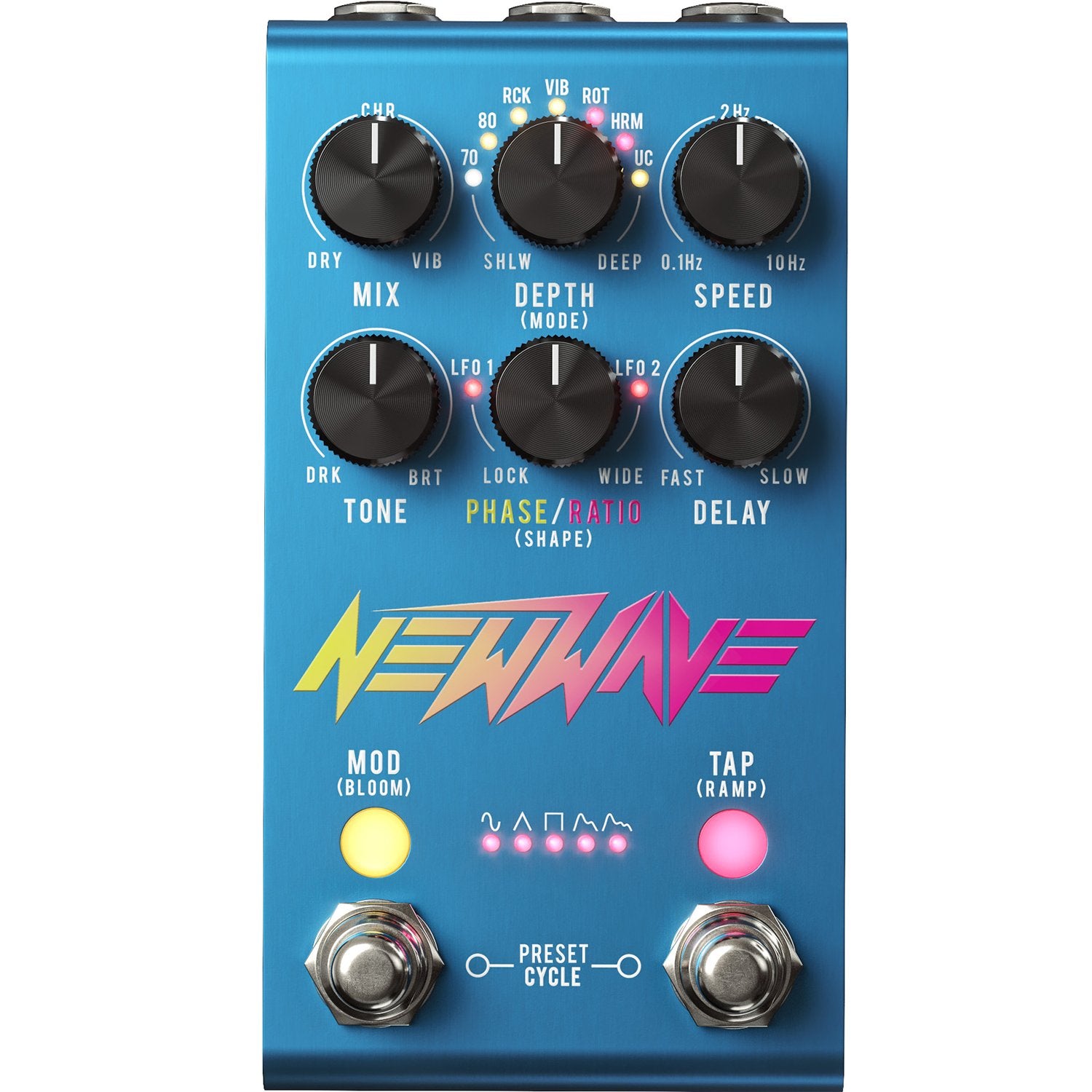
- Seven savable modes (70's, 80's, RCK, VIB, ROT, HRM, UC) cover vintage chorus, vibrato, rotary-speaker, harmonic, and fully custom modulation in one pedal.
- Stereo left and right outputs; the 70's mode is a classic mono chorus, while the other modes use two LFOs for wide stereo movement.
- MIDI control of modes, presets and performance functions, plus tap tempo and expression-pedal control of speed for hands-free changes on stage.
- A BLOOM function fades the effect in and out instead of hard-switching, and RAMP glides between programmable slow and fast speeds like a rotary speaker.
The Seven Modes
- 70's — warm, simple mono chorus in the spirit of the classic CE-1.
- 80's — wide stereo chorus with two LFOs, inspired by the CE-300.
- RCK — 80s rack-style chorus: one channel moves up in pitch while the other moves down.
- VIB — pure analog pitch vibrato with the dry signal removed.
- ROT — two-speed rotary effect that mimics the horn and rotor of a rotary cabinet.
- HRM — harmonic mode: the left and right channels move in a mathematical relationship.
- UC — user control for building your own modulation from scratch.
Controls and switches
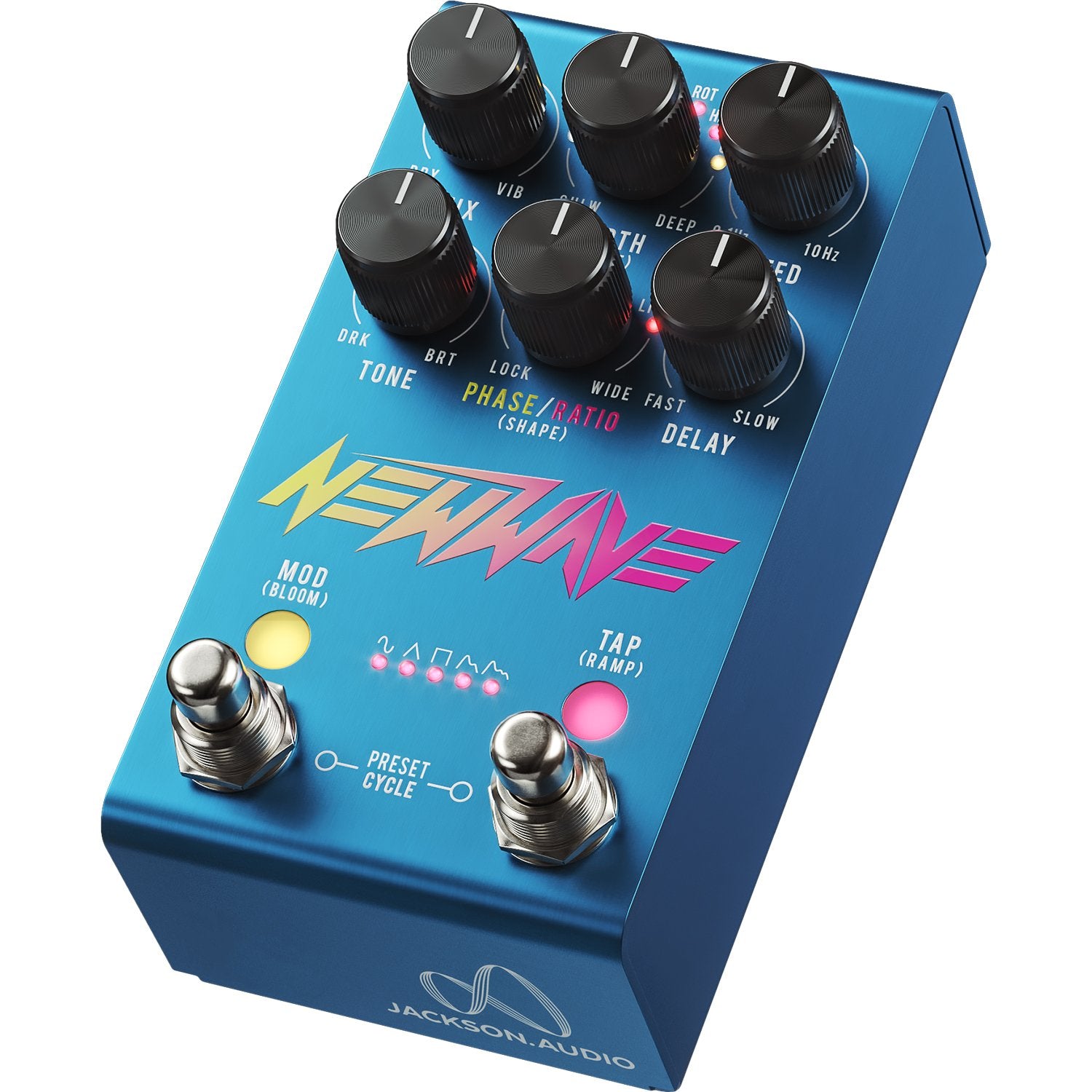
- MIX — Blends dry signal with chorus/vibrato, from fully dry to fully wet.
- DEPTH / MODE — Sets modulation depth; press to step through the 7 modes, press and hold to save the current mode.
- SPEED — Sets the LFO rate from 0.1 Hz to 10 Hz; saved per mode.
- TONE — Shapes the modulated signal from dark to bright.
- PHASE/RATIO (SHAPE) — Sets the stereo LFO phase offset (in sync to 180°) or the speed ratio between channels, depending on mode; press to cycle through 5 LFO wave shapes (sine, triangle, square, Solina and Triplet Solina).
- DELAY — Adjusts the BBD clock center frequency from tight to loose modulation character.
- Bypass footswitch — Engages the effect; also hosts the BLOOM fade-in/out function.
- TAP footswitch — Taps in LFO speed; also triggers RAMP, a programmable speed glide.
- Tap both footswitches together to cycle through presets.
Connections & Power
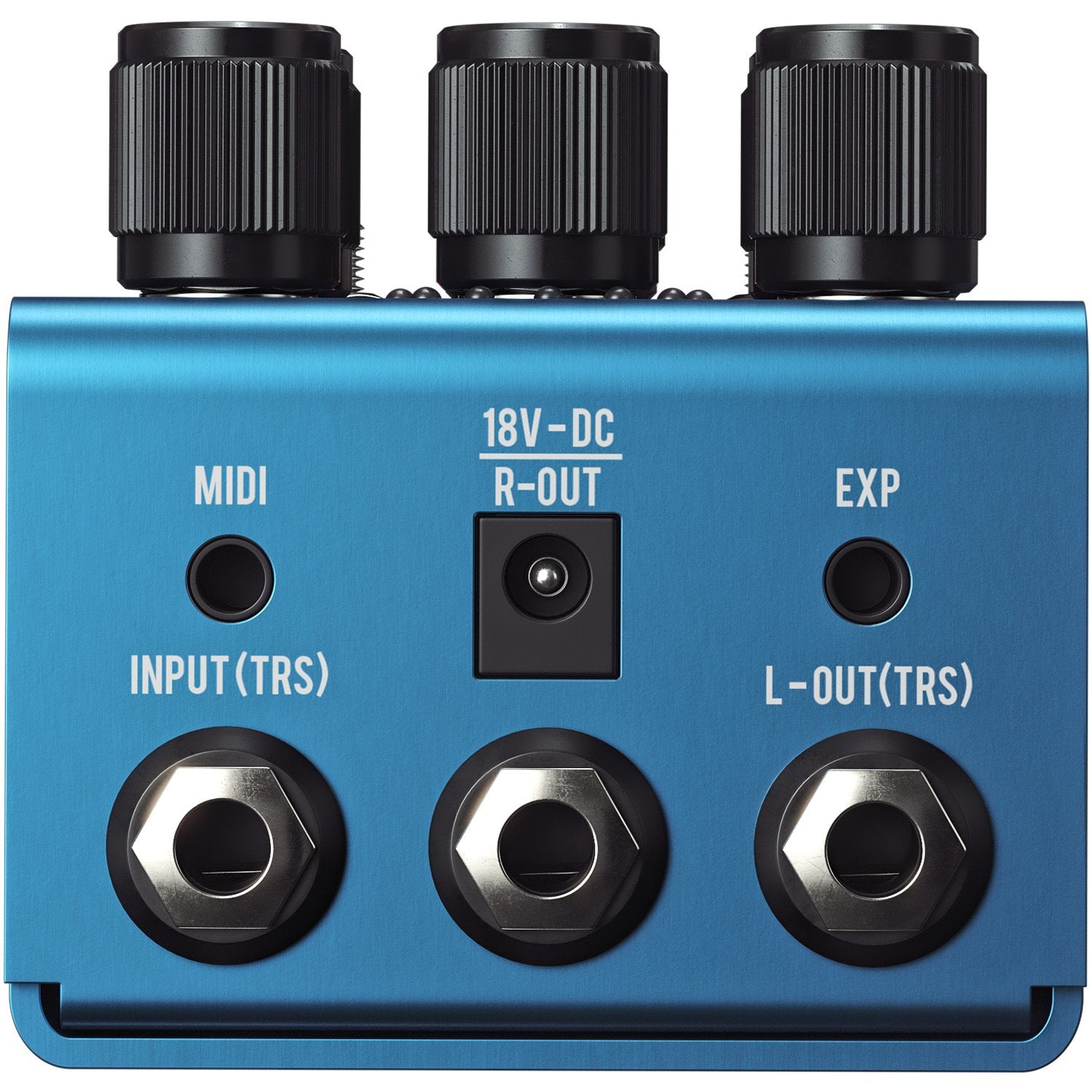
- Stereo outputs (L and R); runs in mono or stereo rigs.
- MIDI input for modes, presets and performance functions.
- Expression pedal input for speed control.
- Requires an 18V DC center-negative supply; current draw 250 mA. Power supply not included.
| Model | Jackson Audio New Wave |
|---|---|
| Effect type | Analog stereo chorus / vibrato / rotary modulation |
| Circuit | 100% analog audio path, MN3007 BBD chips, microprocessor control |
| Modes | 7 savable: 70's, 80's, RCK, VIB, ROT, HRM, UC |
| LFO shapes | 5: sine, triangle, square, Solina, Triplet Solina |
| LFO speed | 0.1–10 Hz |
| Controls | MIX, DEPTH / MODE, SPEED, TONE, PHASE/RATIO (SHAPE), DELAY; bypass and TAP footswitches |
| Outputs | Stereo L / R |
| Control | MIDI, expression (speed), tap tempo |
| Input impedance | 1 MΩ |
| Output impedance | 100 kΩ |
| Power | 18V DC center-negative |
| Current draw | 250 mA |
| Dimensions | 2.7 x 4.875 in (69 x 124 mm) |
| Warranty | 5-year Jackson Audio VIP Warranty |
FAQ
Does the New Wave need an 18V power supply? Yes. The New Wave runs on 18V DC, center-negative, and draws about 250 mA; a standard 9V supply is not enough. Use an 18V outlet or a voltage-doubler cable from two 9V outputs.
Is the New Wave stereo? Yes. It has left and right outputs. The 70's mode is a mono chorus; the 80's, Rack, Rotary and Harmonic modes use two LFOs to spread the modulation across both channels.
Does the New Wave support MIDI? Yes. Modes, presets and performance functions can be controlled over MIDI, while the audio path stays fully analog.
What do BLOOM and RAMP do? BLOOM fades the modulation in and out when you switch the effect instead of turning it on abruptly. RAMP moves the speed between programmable slow and fast settings, like the slow/fast switch on a rotary speaker.
Can I control the speed with my foot? Yes. Use the TAP footswitch for tap tempo, or connect an expression pedal to sweep the speed.
Do my mode settings survive a power cycle? Yes. Settings are saved in each of the seven modes; press and hold DEPTH to save the current mode.