




About This Item
Description
The Meris Ottobit Jr. crushes your guitar or synth signal down to variable sample rates and bit depths, then sequences the destruction across six steps for chiptune, glitch, and 8-bit textures.
Which Meris Ottobit Jr. is this?
Ottobit Jr. is the original two-footswitch bitcrusher: sample-rate and bit crushing without volume scaling or dry blend, a quarter-note-synced stutter, a 6-step sequencer for pitch, filter, or sample-rate patterns, a fixed-resonance Ladder filter, and 16 internal presets. If you want volume-scaled crushing with dry blend, six glitch types including two one-button loopers, three filter types, VHS-style reverb and delay, a 16-step sequencer with roughly 48 parameters, and 99 presets across a screen, that is the Ottobit X, available separately as its own pedal on our site.
Why guitarists choose the Ottobit Jr.
- Independent sample-rate and bit-depth controls dial in everything from subtle grit to full 8-bit collapse.
- 6-step sequencer rhythmically gates the crush effect on and off for chiptune-style patterns.
- Triggered stutter footswitch repeats a slice of audio on demand for glitch effects.
- 16 onboard presets store your favorite crush and sequence settings for instant recall.
- Tap tempo locks the sequencer and stutter timing to your song.
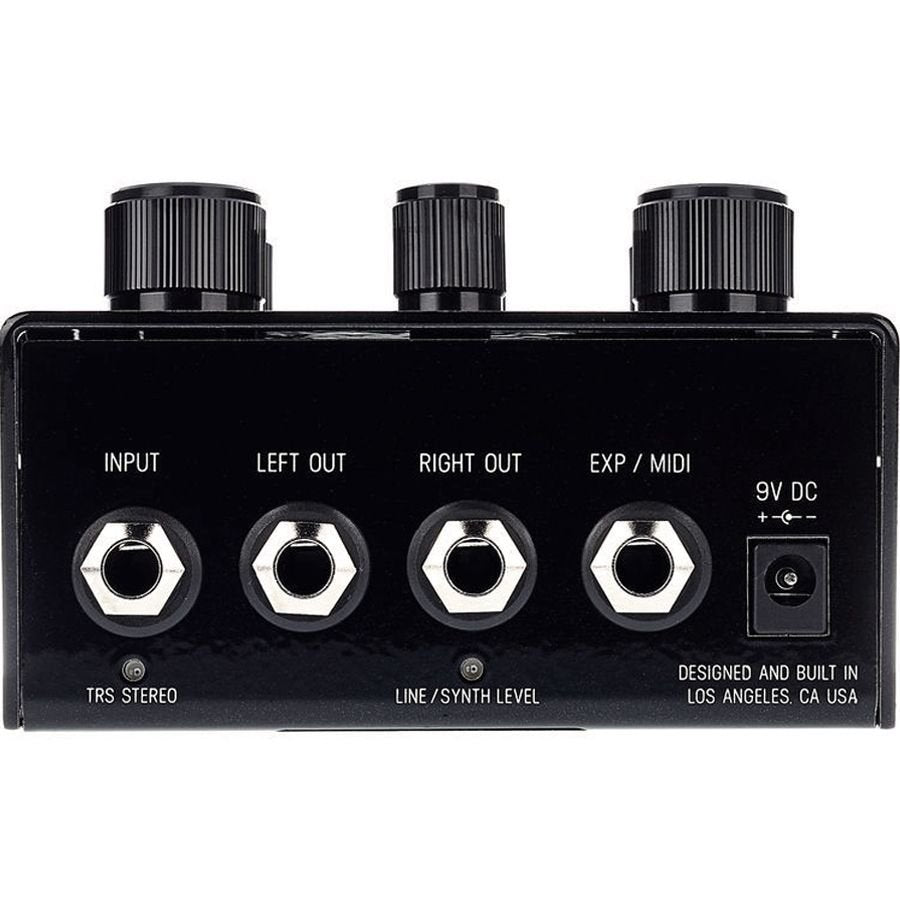
- MIDI over the multi-function EXP jack unlocks full remote control with the Meris MIDI I/O.
Controls and switches
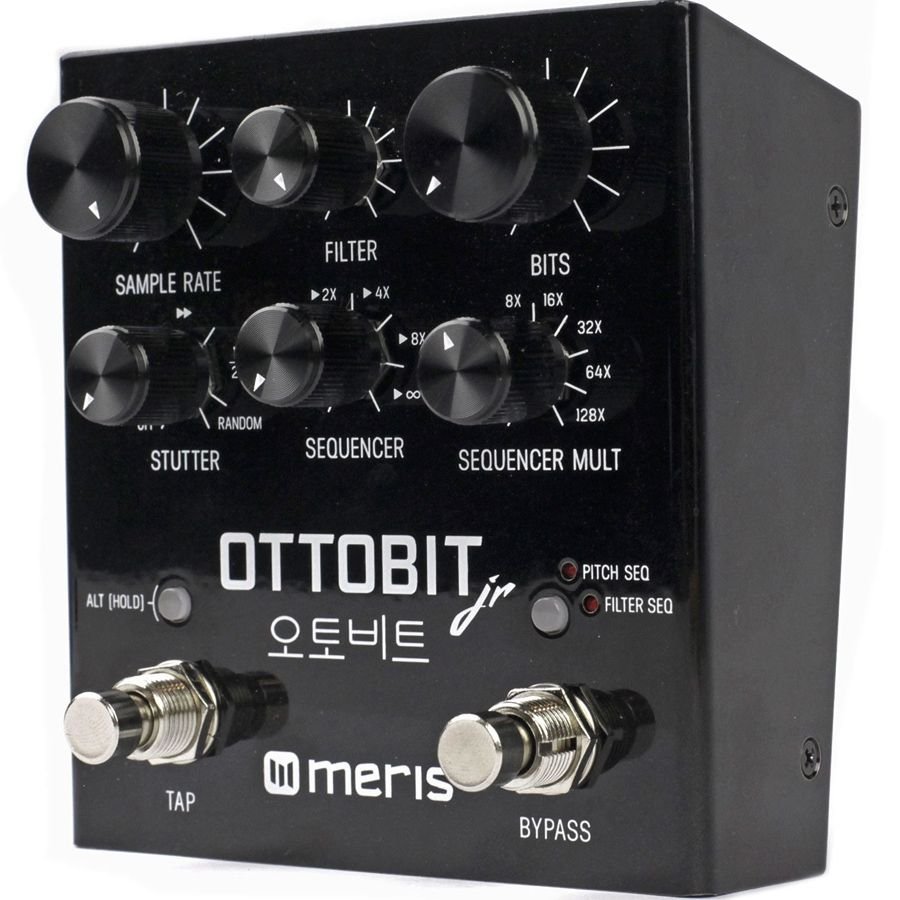
- Sample Rate / Step 1 (Alt) — Sweeps sample rate from 48 Hz to 48 kHz for everything from subtle grit to full digital collapse; Alt sets the value for sequencer Step 1.
- Filter / Step 2 (Alt) — Sweeps the resonant low-pass filter cutoff; Alt sets the value for sequencer Step 2.
- Bits / Step 3 (Alt) — Reduces bit depth from 24 bits down to 1 bit for classic crunchy bitcrushing; Alt sets the value for sequencer Step 3.
- Stutter / Step 4 (Alt) — Dials in triggered stutter repeats on the input signal; Alt sets the value for sequencer Step 4.
- Sequencer Play Mode / Step 5 (Alt) — Chooses how the 6-step sequencer plays back — once, twice, 4x, 8x, or continuous; Alt sets the value for sequencer Step 5.
- Sequencer Multiply / Step 6 (Alt) — Multiplies the sequencer's rate relative to the tapped tempo; Alt sets the value for sequencer Step 6.
- Sequencer Type switch — Assigns the 6-step sequencer to pitch, filter, or sample-rate patterns (small LEDs show which is active; both off runs the sample-rate sequencer).
- Tap footswitch — Taps in the speed and timing of the sequencer and stutter; hold to freeze the stutter buffer for a glitched-out held texture.
- Bypass footswitch — Engages or bypasses the effect.
Power and pedalboard compatibility
Ottobit Jr. runs on 9V DC, center-negative, 2.1 mm barrel, drawing about 150 mA — well within range for a standard isolated pedalboard supply. A power supply is not included. The True Bypass relay is mono, so Ottobit Jr. works fine anywhere in a standard mono chain; because it fully re-samples the signal, most players place it early, right after the guitar or synth and before modulation and time-based effects, so those effects process the crushed signal rather than the other way around. For instant preset recall or full MIDI control without a computer, pair it with the Meris Preset Switch and the Meris MIDI I/O.
Technical specifications
| Model | Meris Ottobit Jr. |
| Effect type | Bitcrusher and Sequencer |
| Topology | Digital |
| Bypass | Selectable relay true bypass or analog buffered bypass |
| Input impedance | 1000 kΩ |
| Power | 9 Volt DC, center-negative, 2.1 mm barrel |
| Current draw | 150 mA |
| Expression input | Yes |
| Onboard presets | Yes |
| Tap tempo | Yes |
| Enclosure dimensions | 11.43 × 10.8 × 5.08 cm |
| Weight | 413.9 g |
| GTIN | 862539000407 |
FAQ
What is the sample rate range?
Adjustable from 48 Hz to 48 kHz, from subtle grit to full digital breakdown.
What bit depths are available?
1 bit to 24 bits.
What can the sequencer control?
The 6-step sequencer can be assigned to pitch, filter, or sample-rate patterns, with play modes of once, twice, 4x, 8x, or continuous.
Can I freeze the stutter?
Yes. Hold the Tap footswitch to freeze the stutter buffer for a held, glitched texture.
What is the difference between Ottobit Jr. and Ottobit X?
Ottobit Jr. crushes sample rate and bit depth with a 6-step sequencer and 16 presets. The Ottobit X adds volume-scaled crushing with dry blend, six glitch types with two one-button loopers, VHS-style reverb and delay, and a 16-step sequencer, and is sold as a separate model on our site.
Can I recall presets without MIDI?
Yes. The first four of Ottobit Jr.'s 16 presets are reachable with the Meris Preset Switch, and all 16 over MIDI with the Meris MIDI I/O.
What power supply does Ottobit Jr. need?
9V DC, center-negative, 2.1 mm barrel, drawing about 150 mA. A power supply is not included.