


About This Item
Description
The Meris Ottobit X is a full-stereo modular degradation and texture engine that pairs advanced bitcrushing with six glitch types, VHS-style delay and reverb, and a 16-step sequencer for deep '80s-inspired sound design.
Which Meris Ottobit X is this?
Ottobit X expands the original two-footswitch Ottobit Jr. into a full-stereo texture engine: volume-scaled bit crushing with dry blend, six glitch types including two one-button loopers (Push Loop and Wikki Wikki vinyl scratching), a 16-step sequencer assignable to roughly 48 parameters instead of a 6-step pitch/filter/rate sequencer, VHS-style delay and reverb, three filter types, five pitch types, and 99 presets across a color screen instead of 16. Ottobit Jr. remains available as its own compact model.
Why guitarists choose the Ottobit X
- Full-stereo bitcrushing and six glitch types cover everything from subtle lo-fi grit to full digital breakdown.
- Two one-button loopers capture and mangle phrases on the fly for live glitch performance.
- VHS-style delay and reverb add analog-tape-decay character on top of the digital destruction.
- 16-step sequencer rhythmically automates crush, glitch, and delay parameters for evolving textures.
- Color screen and 99 onboard presets make deep patches easy to build, name, and recall.
- Native 5-pin DIN MIDI In/Out plus USB-C give full remote control with no external converter box needed.
Modules and Effect Types
- Eleven processing modules: Preamp, Crush, Filter, Glitch, Pitch, Clock, Ambience, Modulate, Mix, Modifiers and Expression
- Crush: sample rate from 48 Hz to 48 kHz and bit depth from 24 bits down to 1 bit, with volume scaling and dry blend
- Glitch (6): Grain Freeze, Stutter, Push Loop, Wikki Wikki, Tape Stop, Stutter Step
- Filter (3): Ladder, State Variable, Otto Tron
- Pitch (5): Poly Chroma, Otto Tune, Micro Tune, Mono Chroma, Lo-Fi
- Modulation (5): Ring Mod, Div Trem, Tape Mod, Freq Shift, Otto Vibe
- Preamp (4): Volume Pedal, Tube, Vinyl, Wavefold
- Ambience (2): VHS Reverb and a dual 2500 ms VHS Delay with play-speed manipulation
- 6 modifiers, including the Hold Modifier envelope generator; the sequencer syncs to MIDI beat clock
- Always-available tuner with configurable reference and output mode
Controls and switches
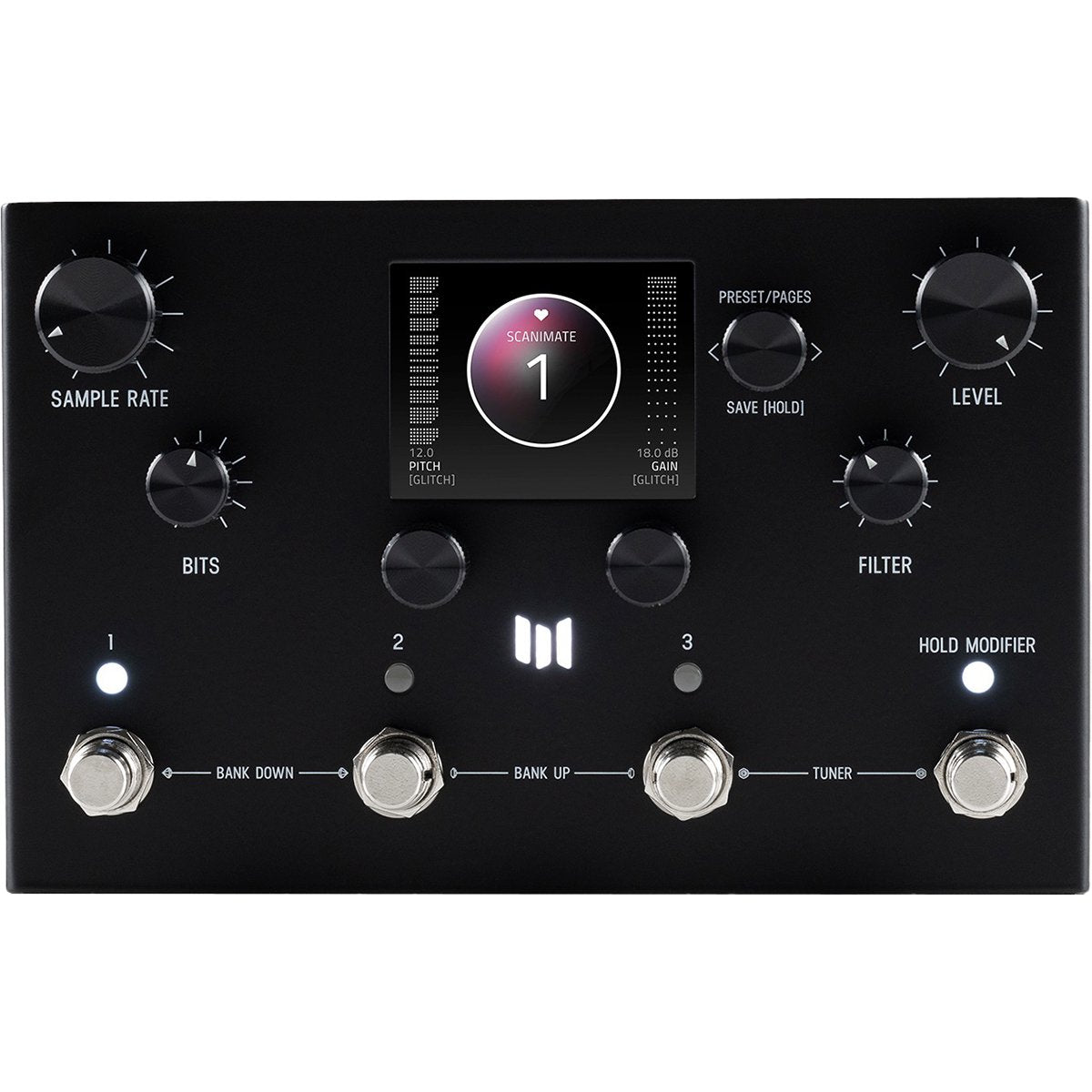
- Sample Rate — Sweeps sample rate from 48 Hz to 48 kHz, with volume scaling and dry blend for a more usable crush than a straight bit-reduction effect.
- Bits — Reduces bit depth from 24 bits down to 1 bit.
- Level and Filter — Dedicated front-panel knobs; the filter works with the Ladder, State Variable, and Otto Tron filter types.
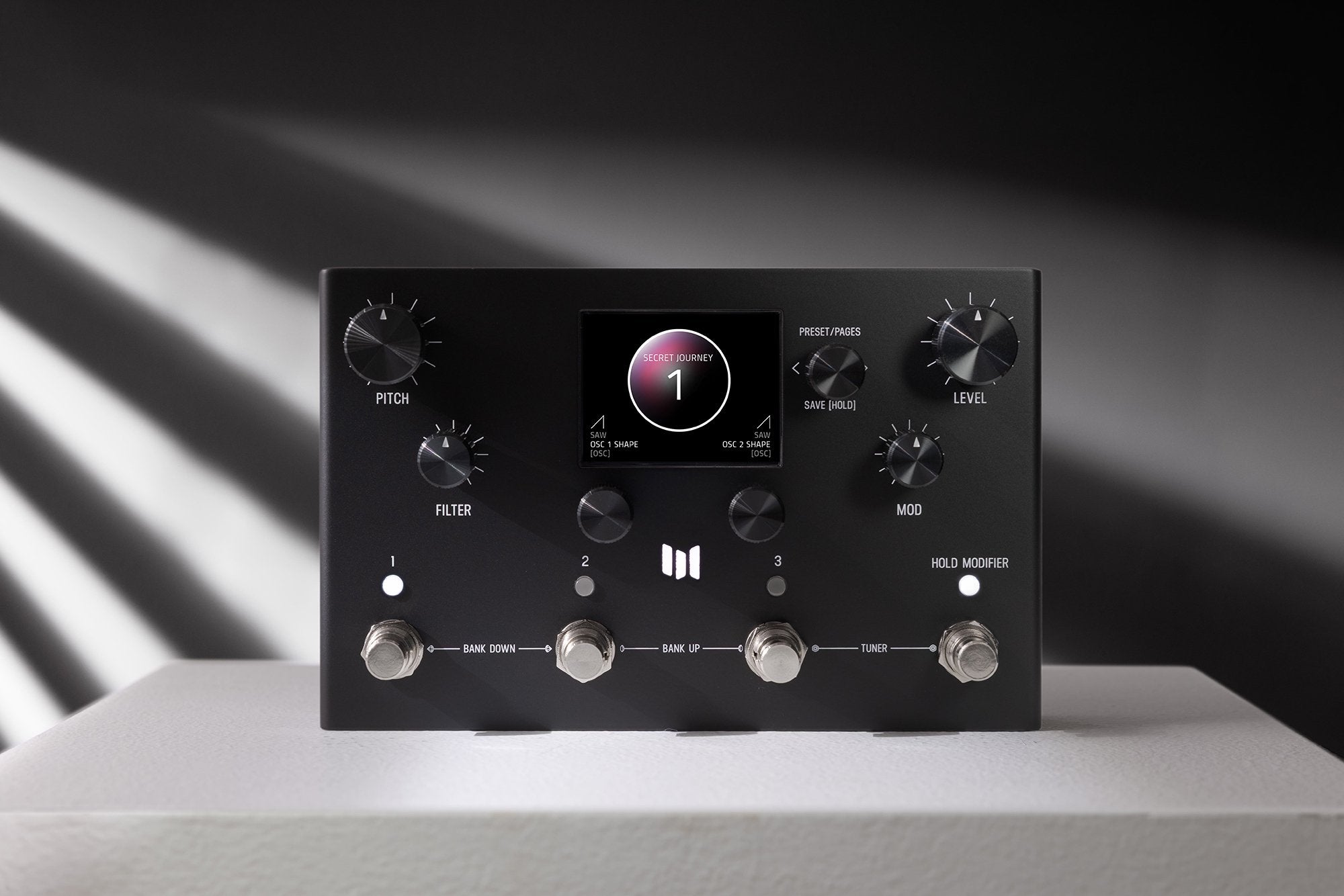
- C1 / C2 / C3 controllers — Edit parameters from the front panel; C3 turns to change presets, pushes to enter edit mode, and holds to save — the way to browse Ottobit X's 99 presets across 33 banks.
- 3 LED buttons (1, 2, 3) — Mirror footswitches 1–3 for desktop and studio use.
- Footswitches 1, 2, 3 — Select and engage presets on the pedalboard.
- Hold Modifier footswitch — An envelope generator switch configurable per preset as Momentary, Latching, or Tap Tempo action — set it to Tap Tempo to sync the sequencer and VHS delay without a dedicated tap footswitch.
- Color LCD — Full-color, dimmable display with logo light.
Connections & Power
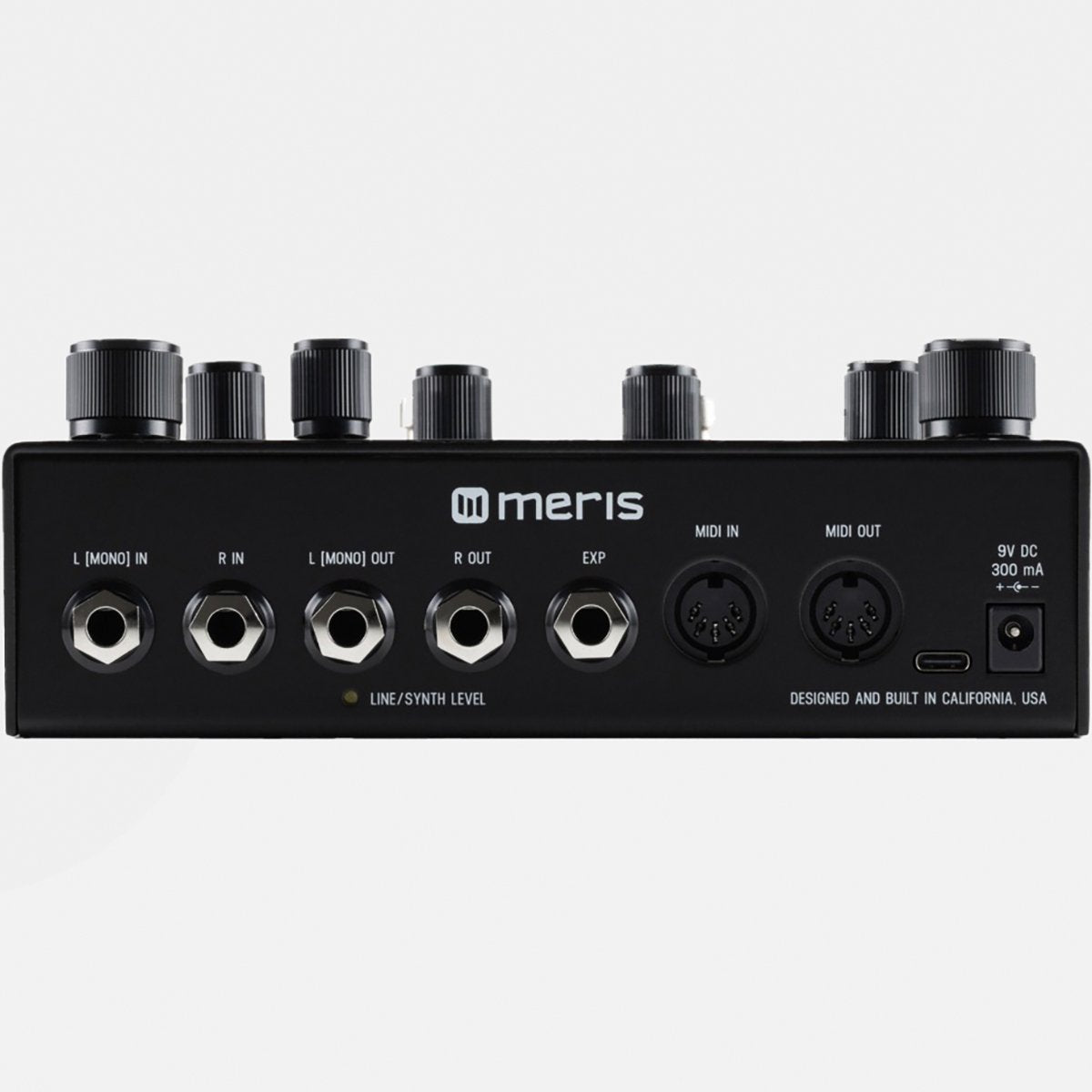
- Stereo input and stereo output, with separate jacks for each side
- Switchable headroom for instrument or synth/line levels: up to +9 dBu instrument, +12.5 dBu line/synth
- Dedicated expression pedal jack; expression can control multiple parameters at once
- 5-pin DIN MIDI In and Out, plus MIDI over USB-C; USB-C also handles firmware updates
- Power: 9V DC center-negative, 2.1 mm barrel, 300 mA minimum — use an isolated supply output rated for that current (power supply not included)
Bypass is selectable between relay true bypass and analog buffered bypass with spillover, so plan pedalboard placement around whichever bypass mode your patch uses.
| Model | Meris Ottobit X |
|---|---|
| Effect type | Modular degradation and texture engine |
| Topology | Digital DSP with analog dry path; 24-bit A/D and D/A, 32-bit floating-point DSP, 48 kHz |
| Stereo | Stereo in, stereo out |
| Bypass | Selectable relay true bypass or analog buffered bypass with spillover |
| Input impedance | 1 MΩ (JFET input) |
| Signal-to-noise ratio | 115 dB typical |
| Frequency response | 20 Hz – 20 kHz |
| Presets | 99 locations in 33 banks, plus a Favorite bank of 3 |
| Sequencer | 16 steps, about 48 assignable parameters |
| Footswitches | 3 preset footswitches + Hold Modifier |
| MIDI / USB | 5-pin DIN MIDI In/Out; USB-C (MIDI and firmware updates) |
| Expression input | Yes, dedicated jack |
| Tap tempo | Via the Hold Modifier footswitch set to Tap Tempo |
| Power | 9V DC center-negative, 2.1 mm, 300 mA minimum (supply not included) |
| Dimensions | 7.25 × 4.5 × 2 in (184 × 114 × 51 mm) |
| Weight | 24 oz (680 g) |
| Made in | California, USA |
FAQ
What glitch types does Ottobit X have? Six: Grain Freeze, Stutter, two one-button loopers (Push Loop and Wikki Wikki vinyl scratching), Tape Stop, and Stutter Step.
Does Ottobit X have delay and reverb? Yes. Two ambience types, VHS Reverb and VHS Delay, including a dual 2500 ms VHS Delay with play-speed manipulation.
What is the difference between Ottobit X and Ottobit Jr.? Ottobit X adds volume-scaled crushing with dry blend, six glitch types with two one-button loopers, VHS delay and reverb, pitch, modulation and preamp modules, a 16-step sequencer, a color screen, and 99 presets. Ottobit Jr. is the original compact two-footswitch version with a 6-step sequencer and 16 presets.
Is it fully stereo? Yes, with separate stereo input and output jacks. The polyphonic pitch shifter type runs in mono.
Does it work with synths and line-level sources? Yes. Input/output headroom switches between instrument level (up to +9 dBu) and synth/line level (up to +12.5 dBu).
What finishes are available? A standard-run Matte Black, or a Limited Edition Multidimensional Pink small run.
Does Ottobit X work with the Meris Preset Switch? Ottobit X selects presets from its own footswitches, front-panel controls and MIDI. The Preset Switch is made for Meris's compact two-footswitch pedals: Enzo, Hedra, Mercury7, Ottobit Jr. and Polymoon.
Does Ottobit X need the Meris MIDI I/O box? No. Ottobit X has its own 5-pin DIN MIDI In/Out jacks plus MIDI over USB-C.
What power supply does Ottobit X need? 9V DC, center-negative, 2.1 mm barrel, at least 300 mA. A power supply is not included.