


About This Item
Description
The Meris Polymoon stacks a 1200 ms multiple-tap delay with six custom LFOs, a tempo-syncable barberpole phaser, and a dynamic flanger for tidal, dream-state soundscapes.
Which Meris Polymoon is this?
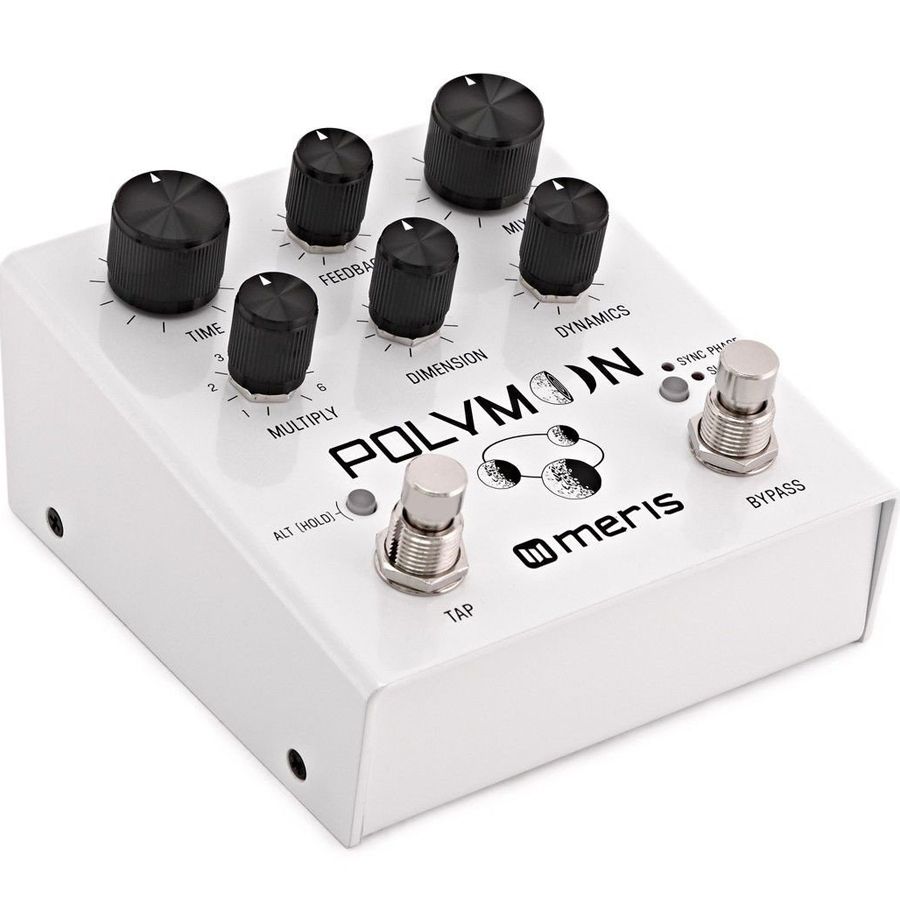
Polymoon is a fixed-architecture 1200 ms super-modulated multi-tap delay with six knobs, two footswitches, and 16 presets, inspired by cascaded rack gear. Its signal flows through parallel dynamic flangers, six serial multi-tap delays, and a pair of barberpole phasers, one per stereo side. Meris's larger LVX modular delay system shares many processing elements with Polymoon but does not fully replicate its engine, and the two pair well on the same board.
Why guitarists choose the Polymoon
- Up to 1200 ms of multi-tap delay creates dense, evolving echo textures beyond a standard single-tap delay.
- Six custom LFOs continuously modulate the delay taps for tidal, ever-shifting movement.
- Tempo-syncable barberpole phaser and dynamic flanger add swirling motion without extra pedals.
- 16 onboard presets store your favorite modulated-delay soundscapes for instant recall.
- Trails-enabled bypass lets delay and modulation tails ring out naturally after you switch off.
- MIDI over the multi-function EXP jack unlocks full remote control with the Meris MIDI I/O.
Controls and switches
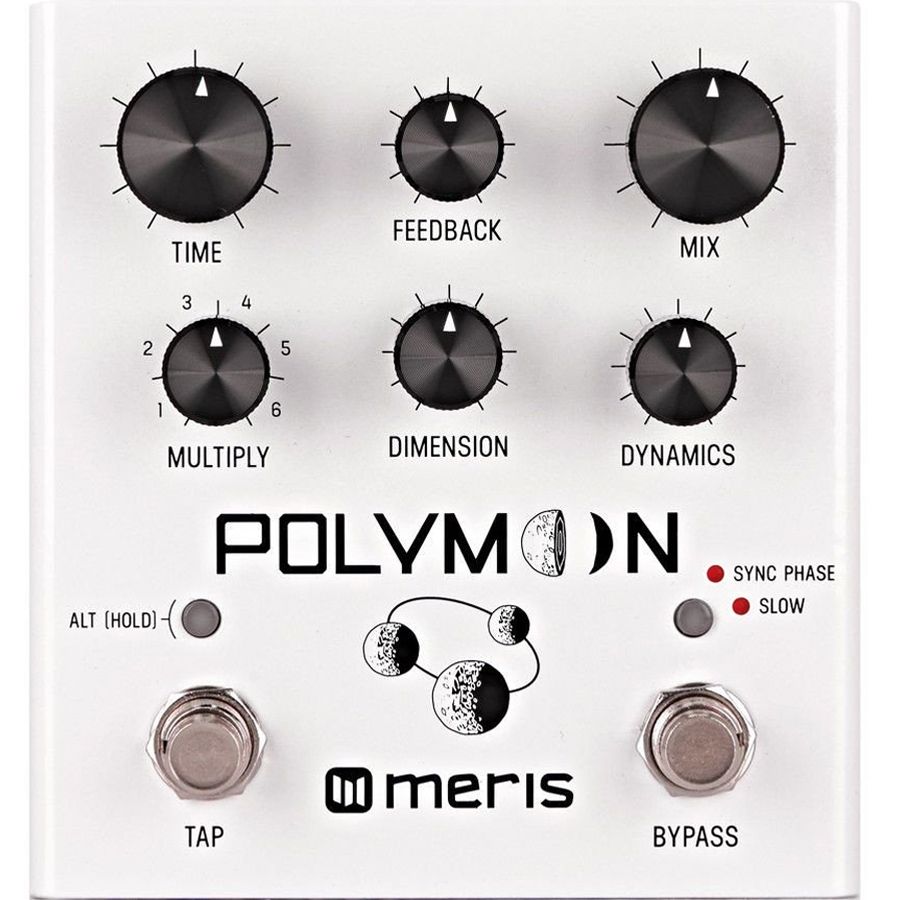
- Time / Early Modulation (Alt) — Sets the base delay time up to 1200 ms and the synced phaser speed; Alt sets the depth of triangle-wave modulation applied to the early delay taps.
- Feedback / Feedback Filter (Alt) — Controls how many times delay repeats feed back into themselves; Alt tilts an EQ filter inside the feedback path — noon is flat, lower is darker, higher is brighter.
- Mix / Delay Level (Alt) — Blends delay with dry signal; Alt trims delay output level from 0 dB down to -12 dB, with automatic level scaling at minimum.
- Multiply / Late Modulation (Alt) — Sets how many delay taps are added to the output for denser repeats; Alt sets modulation depth applied to later taps.
- Dimension / Dynamic Flanger Mode (Alt) — Smears and sustains reflections for added dimension; Alt selects the Dynamic Flanger's response mode — Envelope Down, Envelope Up, or LFO.
- Dynamics / Dynamic Flanger Speed (Alt) — Sets the intensity of the stereo dynamic flanger (off at minimum); Alt sets the flanger's envelope attack time or LFO speed, depending on mode.
- Alt button — Hold to access the Alt functions of the knobs and footswitches.
- Phaser select button — Chooses Slow (fixed 0.1 Hz), Sync (locked to a quarter note of the delay time), or Slow + Sync (locked to a whole note) for the built-in barberpole phaser, or turns it off.
- Tap footswitch / Dotted Eighth (Alt) — Taps in delay and synced phaser time; hold for half-speed delay. Alt switches the tapped subdivision from quarter notes to dotted eighth notes.
- Bypass footswitch / Dynamic Flanger Feedback (Alt) — Engages or bypasses the effect; Alt sets feedback amount for the Dynamic Flanger.
Connections & Power
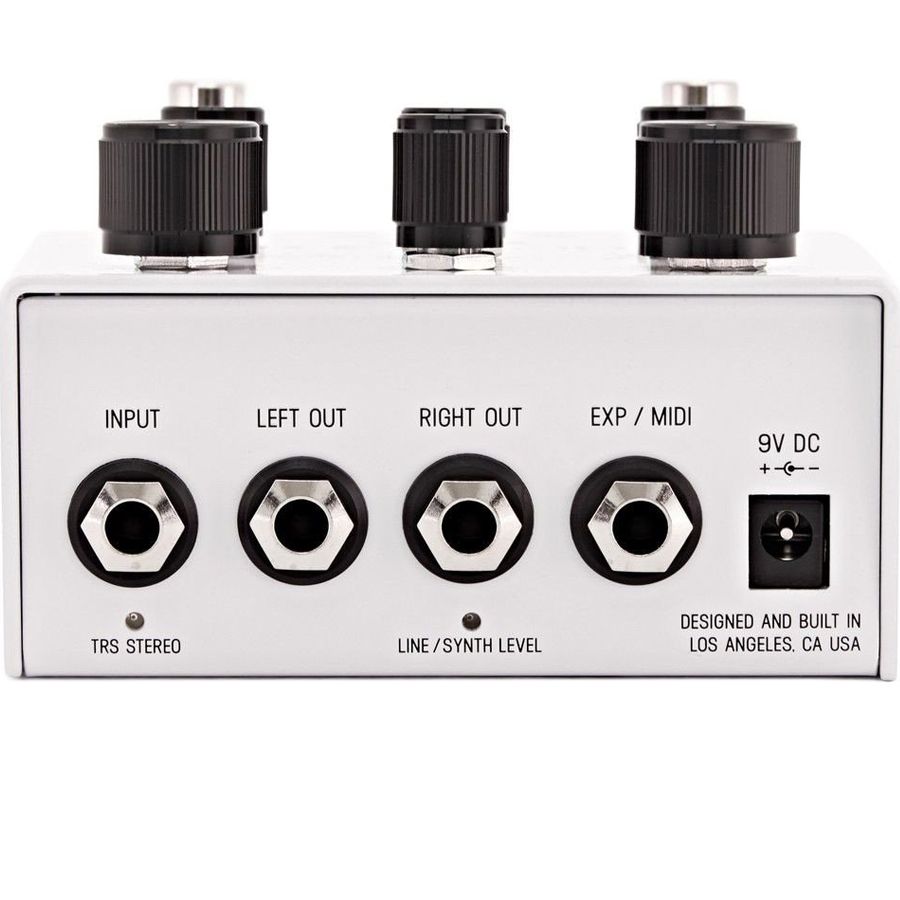
- Stereo input (switchable mono/stereo, TRS) and left/right outputs
- Switchable input/output headroom for guitar, synth, or line levels
- Multi-function EXP jack: expression pedal (controls all parameters at once, morphing between toe-up and toe-down settings), external tap switch, Meris Preset Switch, or MIDI through the Meris MIDI I/O
- MIDI CC control, MIDI beat clock sync, and SysEx preset backup via the MIDI I/O
- Power: 9V DC center-negative, 2.1 mm barrel, under 150 mA — no battery; power supply not included
Bypass is selectable between relay true bypass and analog buffered bypass, set in the global configuration. With Trails enabled, delay and modulation trails ring out naturally after bypass; a Glide option keeps the delay buffer running between presets for smooth transitions. Most players place Polymoon last or near-last in the chain, after drive and modulation. For instant preset recall without a computer, pair it with the Meris Preset Switch; for full MIDI control, use the Meris MIDI I/O.
| Model | Meris Polymoon |
|---|---|
| Effect type | Super-modulated multiple-tap delay |
| Delay time | Up to 1200 ms |
| Modulation | 6 LFOs, stereo barberpole phaser, stereo dynamic flanger |
| Topology | Digital, 24-bit A/D and D/A, 32-bit floating-point DSP; analog dry path |
| Stereo | Stereo in (switchable mono/stereo), stereo out |
| Bypass | Selectable relay true bypass or analog buffered bypass; Trails option |
| Presets | 16 (1–4 via Preset Switch, 1–16 via MIDI) |
| Expression / MIDI | Multi-function TRS EXP jack (expression, tap, Preset Switch, MIDI via MIDI I/O) |
| Tap tempo | Yes, onboard footswitch (quarter or dotted eighth) |
| Power | 9V DC center-negative, 2.1 mm, under 150 mA (supply not included) |
| Battery | No |
| Dimensions | 4.25 × 4.5 × 2 in (108 × 114 × 51 mm) |
| Weight | 14.5 oz (410 g) |
| Finish | White powder coat with fine iridescent flake |
| Made in | California, USA |
FAQ
How long is the delay? A 1200 ms real-time selectable multiple-tap delay line.
What does Multiply do? It sets how many delay taps are added to the output for denser, more layered repeats.
How many LFOs does Polymoon have? Six custom-tuned LFOs with adjustable waveforms, split into separate Early and Late Modulation.
What phaser modes are available? Slow (fixed 0.1 Hz stereo barberpole), Sync (locked to a quarter note of the delay time), and Slow + Sync (locked to a whole note), or off.
Is Polymoon stereo? Yes. The input switches between mono and stereo, and there are separate left and right outputs.
Do the delays ring out when I switch it off? Yes, with the Trails option enabled in the global settings, repeats decay naturally after bypass.
What is the difference between Polymoon and LVX? Polymoon is a fixed 1200 ms multi-tap delay engine in a compact two-footswitch pedal. LVX is Meris's larger modular delay system with a color screen and 99 presets; it shares processing elements with Polymoon but cannot fully replicate its engine, so the two pair well together.
Can I recall presets without MIDI? Yes. The first four of Polymoon's 16 presets are reachable with the Meris Preset Switch, and all 16 over MIDI with the Meris MIDI I/O.
What power supply does Polymoon need? 9V DC, center-negative, 2.1 mm barrel, drawing under 150 mA. A power supply is not included.